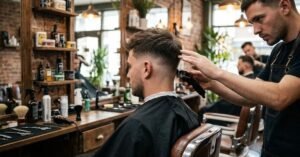
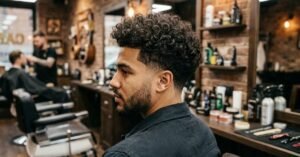
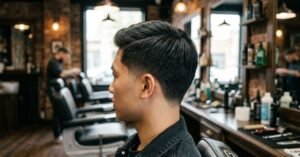
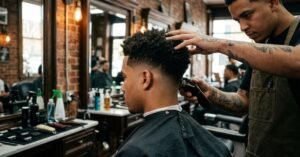
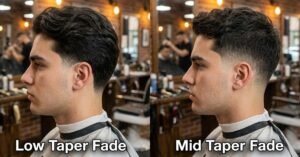
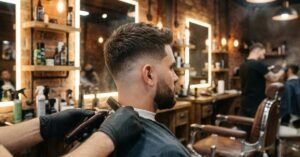
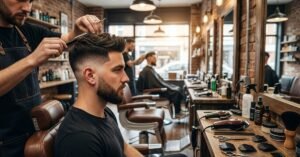
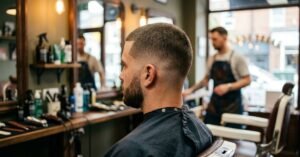
A drop fade is a fade haircut where the fade line curves down behind the ear instead of running straight around the head. It gives the sides and back a rounded, tapered shape that follows your skull.
This guide covers the types, who each one suits, how it compares with other fades, and the exact words to use in the barber’s chair.
What is a drop fade?

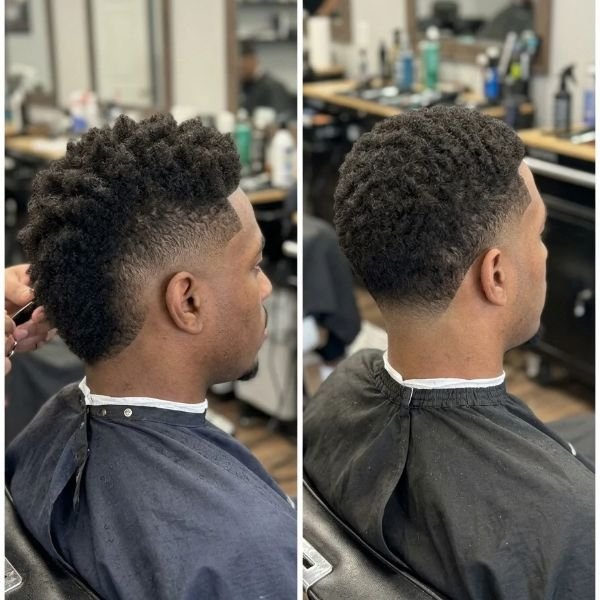
A drop fade is a fade that starts at the front of the head and then “drops” in a curve behind the ear toward the nape of the neck. The sides blend from short hair to longer hair along that curved line.
Quick answer: a drop fade is a curved fade that dips lower behind the ear.
It works with almost any top, from a buzz cut to curls, which is a big reason barbers get asked for it so often.
What does the “drop” in drop fade mean?
The “drop” is the downward arc of the fade line. In front of the ear, the line sits higher. Behind the ear, it falls toward the neckline.
That arc does two jobs:
- It follows the natural curve of your head.
- It leaves more length at the back, which helps balance the shape from the side.
How is a drop fade different from a regular fade?
| Feature | Regular fade | Drop fade |
|---|---|---|
| Fade line | Mostly level | Curved, drops behind the ear |
| Back of head | Same height as sides | Lower, rounder arc |
| Look | Clean and uniform | Sculpted and shaped |
Low, mid, high and skin drop fades: what changes?
The height tells you where the fade starts. The finish tells you how short it gets at the bottom.
Low drop fade
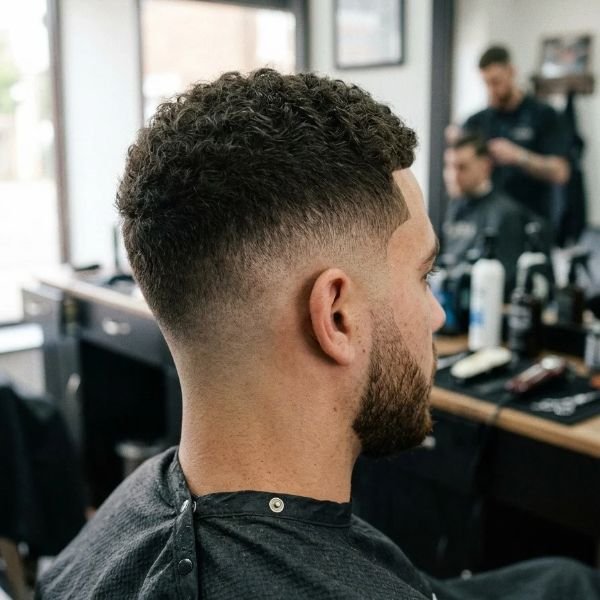
The low version starts near the ear and sits close to the hairline. It is subtle and easy to wear to work. It keeps more hair on the sides and grows out softly.
Mid drop fade

The mid version begins around the temple, about level with the outer corner of the eyebrow. It balances contrast and neatness, and it suits most people who are unsure where to start.
High drop fade

The high version starts higher on the head, near the upper temple. It creates the strongest contrast and a bold, sharp look. It also shows grow-out faster.
Skin drop fade vs #0.5 or #1 finish
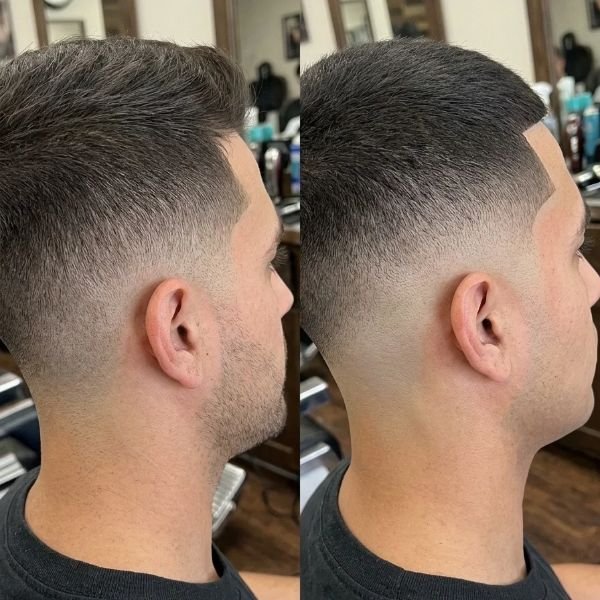
The skin version goes down to bare skin at the bottom. A #0.5 or #1 finish leaves a faint shadow of hair.
- Skin (#0 or foil shaver): sharpest look, shows growth quickly, can irritate sensitive scalps.
- #0.5: nearly skin, with a softer edge.
- #1: about 3 mm. Easier to live with and kinder to the scalp.
Guard names vary by clipper brand, so confirm the length with your barber.
Read more: Burst fade haircut: what it is, types, styles and barber guide
Which drop fade suits your hair and head shape?
By hair texture and density
- Straight hair: this cut gives a clean outline. Add texture on top so the cut does not look flat.
- Wavy hair: the contrast shows off natural movement.
- Curly and coily hair: the fade frames the curls and keeps the sides tidy.
- Thick hair: a mid or high fade removes bulk from the sides.
- Fine or thin hair: a low fade is safer, because a high fade can make thin hair look sparse.
By head and face proportions
- Round face: a mid or high fade slims the sides. Add height on top.
- Square face: a low or mid fade softens a strong jaw.
- Oval face: most versions work.
- Long face: keep the fade lower and the top shorter so you do not add height.
- Flat back of head: the curved drop adds shape behind the ear.
Hairline, crown and beard considerations
- Receding hairline: keep the top longer and the fade lower. It draws attention away from the temples.
- Cowlick or crown swirl: tell your barber so the top length can be planned around it.
- Beard: blend the fade into the beard so the transition is smooth. A skin fade into a full beard looks sharp, but it needs regular touch-ups.
Drop fade styles to show your barber
Short, textured and buzzed tops
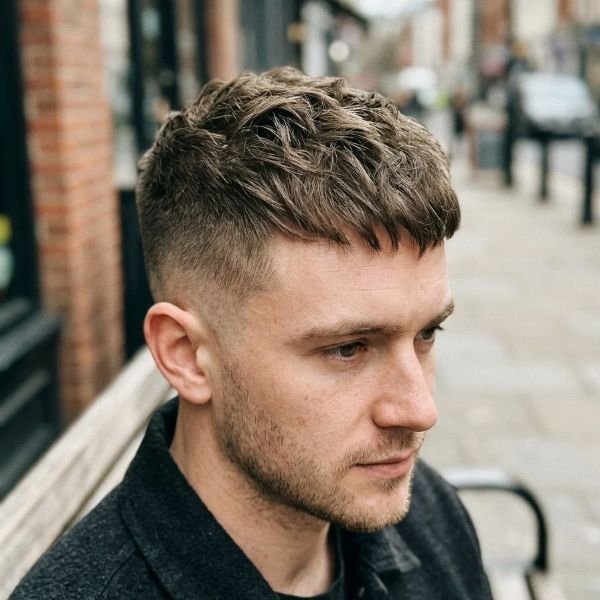
A buzz cut or short crop on top is the lowest effort option. A textured crop adds a little movement, and it takes under two minutes to style.
Curly, coily and high-volume tops

Keep the top at least 2 to 4 inches so the curl pattern shows. The fade keeps the sides crisp while the top stays full. Moisturize and define curls with a cream.
Medium and longer tops

It also pairs with a quiff, slick back, or messy fringe. Longer tops need more product, and the contrast with the faded sides looks sharper.
Drop fade with a beard or line-up

A line-up (also called an edge-up) sharpens the hairline at the forehead and temples. Add a line-up and you get a very clean frame. Ask whether you want a natural or sharp line before the barber starts.
Drop fade vs low fade, taper fade and burst fade
Drop fade vs low fade

A low fade is a level fade that starts low around the head. A drop fade follows a curved path that dips behind the ear. Combine both and you get a low drop fade: a curve with a low starting point.
Drop fade vs taper fade
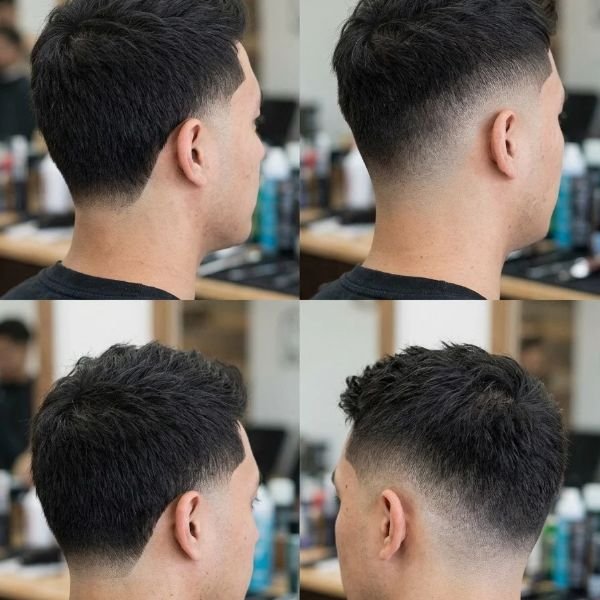
A taper fade shortens the hair mainly at the edges, such as the sideburns and neckline, and it keeps more length overall. The drop version goes further, with a visible curve. A taper is softer. It is more dramatic.
Drop fade vs burst fade
| Fade | Shape | Best for |
|---|---|---|
| Drop fade | Curved, dips behind the ear | Rounded, sculpted sides |
| Low fade | Level, starts low | Subtle, office friendly |
| Taper fade | Edges only | Soft, natural grow-out |
| Burst fade | Half circle around the ear | Mullets and longer backs |
What should you ask your barber for a drop fade?
Use this five-part barber brief
Say these five things in order:
- Fade type: “A drop fade, please.”
- Starting height: low, mid, or high.
- Bottom finish: skin, #0.5, or #1.
- Top length: give inches or the guard number.
- Neckline and line-up: natural or sharp, with or without an edge-up.
Example: “A mid drop fade, down to a #1 at the bottom, three inches on top with some texture, and a natural neckline.”
Read more: Low taper fade buzz cut: styles, lengths, face shapes, and maintenance
What kind of reference photo should you bring?
Bring three photos: front, side, and back. A front-only picture hides the curve. Choose a photo with similar hair texture to yours, because a curly model’s cut will not look the same on straight hair.
Common drop fade request mistakes
- Asking for “a fade” without naming the type.
- Skipping the starting height.
- Not stating the bottom finish, so the barber guesses skin or #1.
- Showing only a front photo.
- Not mentioning a cowlick, scalp sensitivity, or beard.
- Asking for a skin fade when you want low upkeep.
How do you maintain a drop fade?
How often should you refresh a drop fade?
| Finish | Typical refresh |
|---|---|
| Skin or high drop fade | Every 2 to 3 weeks |
| Mid drop fade | Every 3 to 4 weeks |
| Low drop fade | Every 3 to 5 weeks |
Styling and grow-out between barber visits
- Use a matte clay or paste on top and a light cream for curls.
- Keep the neckline clean with a small trim, and leave the fade itself to your barber.
- As the cut grows out, the contrast softens first. Switch to a slightly longer top to keep the shape balanced.
- Wash two to four times a week, and moisturize dry ends.
What if a skin fade irritates your scalp?
Ask for a #0.5 or #1 finish instead of bare skin. Moisturize after the cut, avoid harsh aftershave, and wear sunscreen on exposed skin.
If redness, bumps, or ingrown hairs keep returning, see a dermatologist.
Read more: Mid Taper Fade: Styles, Barber Instructions, and Maintenance
Drop fade FAQs
What is a drop fade haircut?
It is a fade that curves down behind the ear, giving the sides and back a rounded, tapered shape.
Is a drop fade the same as a low fade?
No. A low fade describes the starting height, while a drop fade describes the curved path of the line. They can be combined.
What is the difference between a drop fade and a taper fade?
A taper fade only shortens the edges and is softer. A drop fade creates a more visible curved fade.
How long does a drop fade last?
Most look sharp for 2 to 4 weeks, depending on the height and finish.
What should I say to my barber?
Name the height, the bottom finish, the top length, and the neckline, such as “mid drop fade to a #1 with three inches on top.”
Does a drop fade work on curly or thick hair?
Yes. It frames curls and removes bulk from the sides of thick hair.
Can I get a drop fade with a beard?
Yes. Ask the barber to blend the fade into your beard for a smooth transition.
Conclusion
This cut is a simple way to add shape to the sides and back. Choose the height that fits your hair and face, pick a finish that matches your scalp and schedule, and use the five-part brief so your barber knows exactly what you want.
Bring three photos, name the details, and plan your refresh every few weeks. Do that, and the cut will look the same in your mirror as it did in the photo.