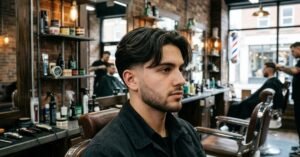
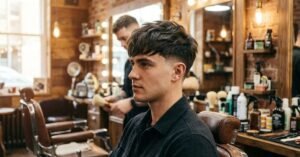
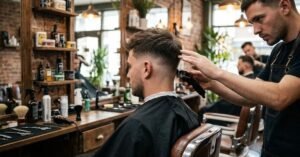
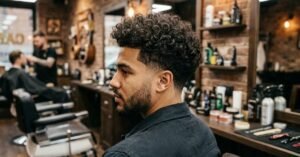
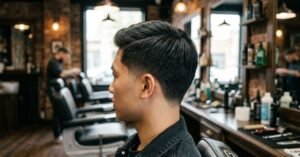
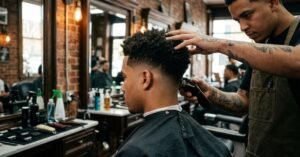
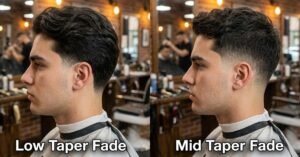
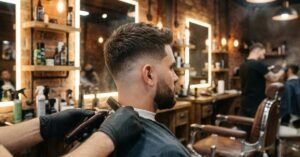
A low taper fade fringe pairs a soft, short blend around the sideburns and neckline with a longer top that falls forward over the forehead. The sides stay neat, the top stays expressive, and the grow-out looks natural rather than awkward.
It suits most hair types, takes about five minutes to style, and works for school, the office and weekends.
This guide explains how the cut looks, who it flatters, how to describe it to your barber, which products work, what it costs and how often to book. It also covers 20 fringe and crop variations so you can pick one with confidence.
What is a low taper fade fringe?
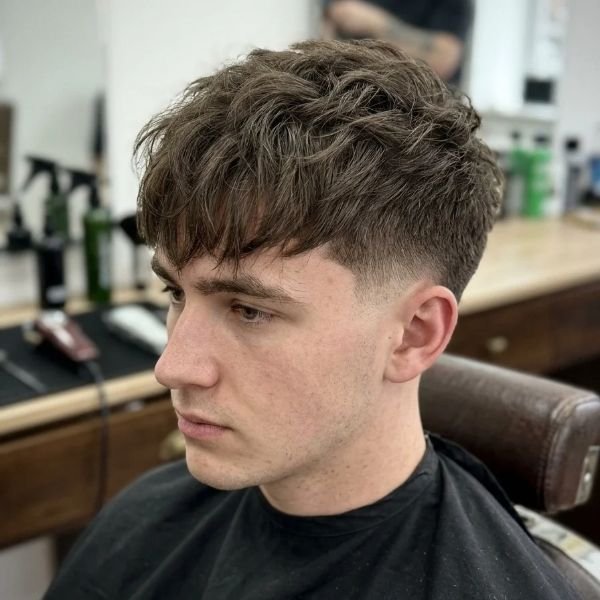
A low taper fade fringe is a haircut where the hair shortens gradually only at the lowest part of the head, around the ears, sideburns and nape. The top is left long enough to create a fringe, which is the hair that sits over the forehead.
Three parts define the cut:
- Low: the blend starts near the ears and neckline, not up at the temples.
- Taper: the length shortens gradually, so there is no hard line.
- Fringe: the front stays longer and is styled forward, sideways or in a textured sweep.
A taper usually keeps some hair at the very bottom. A skin fade goes down to the bare skin. That difference makes the low taper easier to wear and easier to grow out.
What it looks like from the front, side, and back
From the front, you see a fringe sitting between your eyebrows and hairline, with clean, short sides framing the face. The cut looks balanced because the sides add no bulk.
From the side, the hair around the ear is short and neat. The blend rises only a little before the longer top length takes over. The sideburn area should look soft, not shaved.
From the back, the neckline can be tapered, squared or rounded. A tapered neckline grows out best. Ask your barber to keep the nape blend low so the back looks tidy for weeks.
How it compares to similar cuts
| Cut | Where the blend starts | Contrast | Typical touch-up |
|---|---|---|---|
| Low taper fringe | Around ears and nape | Soft | 3 to 5 weeks |
| Low skin fade fringe | Same height, down to skin | Sharper | 2 to 3 weeks |
| Mid fade fringe | Around temple level | Moderate | 2 to 3 weeks |
| High fade fringe | Above the temples | Strong | 2 weeks |
| Scissor-cut crop | No clipper fade | None | 6 to 8 weeks |
Who does it suit?
This cut suits most men and teens because the fringe can be adjusted to nearly any hair type. It works especially well for:
- Students and young professionals who want a neat but relaxed look.
- Men with thick hair, since the low taper removes bulk only where it matters.
- Men with wavy or curly hair, who can use the length on top for natural shape.
- Men with a receding hairline, because a fringe softens the forehead area.
Very thin or fine hair can still work, but keep the fringe shorter and textured so it does not look flat. Very tight coils may need a slightly different technique, so mention your curl pattern to your barber at the start.
Best fringe for your face shape

| Face shape | Best fringe | Why it works |
|---|---|---|
| Oval | Almost any style | Balanced proportions suit most lengths |
| Round | Textured, angled or side-swept | Adds height and breaks up width |
| Square | Soft, messy or curtain fringe | Softens a strong jawline |
| Long or oblong | Straight, heavier fringe | Shortens the look of the forehead |
| Heart | Side-swept or wispy fringe | Balances a wider forehead |
| Diamond | Curtain or textured fringe | Adds width at the forehead |
20 best low taper fade fringe styles
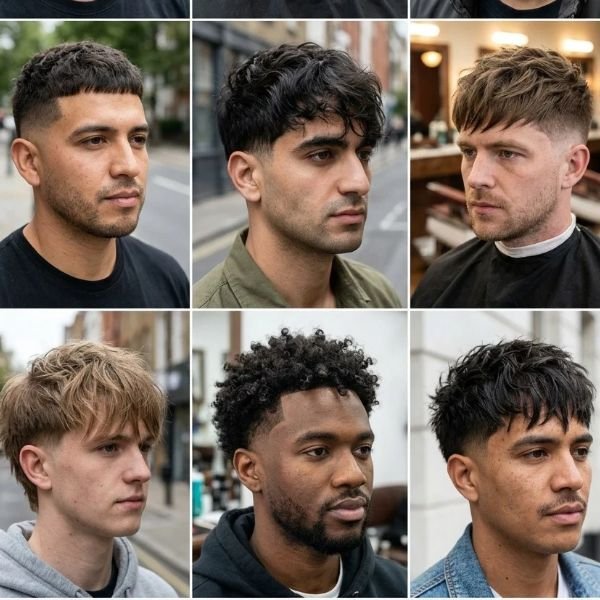
Each style below pairs the same low taper with a different top. Add one photo per style to help readers visualize it.
- Classic blunt fringe: a straight line just above the brows. Clean and bold.
- Textured fringe: point cut for movement. The most popular everyday option.
- Curtain fringe: parted in the middle and falling to both sides.
- Side-swept fringe: brushed across the forehead for a classic look.
- Messy fringe: loose and tousled with matte product.
- Fluffy fringe: extra volume from blow-drying. Good for thick hair.
- Middle-part fringe: symmetrical and relaxed, popular with longer tops.
- Short cropped fringe: a compact, low-effort version.
- Long Korean-style fringe: soft, layered and often worn over the eyebrows.
- Piecey textured fringe: separated strands with a defined, choppy finish.
- Angled side fringe: cut diagonally for a sharp edge.
- Curly fringe: natural curls styled forward with a curl cream.
- Wavy fringe: loose waves left to fall naturally.
- Edgar cut fringe: a squared, blunt fringe with a very clean line-up.
- Comma fringe: the front curls slightly into a comma shape.
- Two-block fringe: short sides and a longer, separated top section.
- Faux hawk fringe: the top is pushed up in the centre, with a fringe at the front.
- Disconnected fringe: a visible gap between the taper and the top.
- Wispy feathered fringe: light, thin ends for fine hair.
- Slicked-back fringe variation: the same cut brushed back for formal events.
Pick one that matches your hair density and your styling patience. Cropped and textured versions are the easiest for beginners, while curtain and long Korean-style fringes need more regular trims.
How long should your hair be?

| Top length | Result |
|---|---|
| 1 to 2 inches | Short crop, a fringe that barely reaches the forehead |
| 2 to 3 inches | The most versatile textured fringe |
| 3 to 4 inches | Full fringe that can be swept or parted |
| 4 inches and longer | Curtain or Korean-style fringe |
In the barber’s chair: what to ask for and what to expect
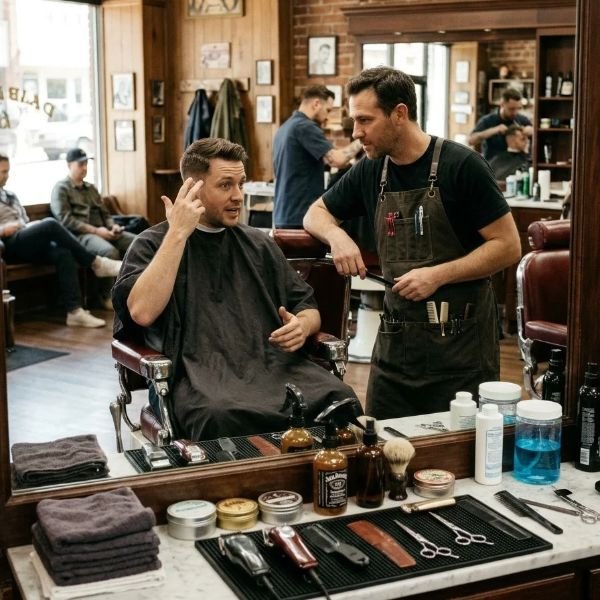
Clear instructions prevent most bad haircuts. Use this simple script:
“I’d like a low taper fade blended around my sideburns and neckline, not higher up. Keep the sides soft, and leave a textured fringe about two to three inches long, styled forward with a natural finish.”
Then follow these tips:
- Bring photos showing the front, side and back.
- Say whether you want a natural or polished finish.
- Mention your hair type, cowlicks and usual styling routine.
- Use your fingers to show where the fringe should end.
- Ask for point cutting if you want texture, not thinning.
A typical appointment follows this order. The barber checks your growth pattern and density, sections off the top, builds the low blend with clippers, cuts and texturizes the fringe, then cleans the neckline and sideburns. The whole process usually takes 30 to 45 minutes.
How to style it at home

Styling takes a few minutes if you follow a consistent routine:
- Wash and towel dry until the hair is damp, not wet.
- Apply a pea-sized amount of sea salt spray or mousse at the roots.
- Blow-dry the fringe forward with a round brush or your fingers.
- Warm a small amount of clay, paste or cream between your palms.
- Work it through the fringe, starting from the back and moving forward.
- Shape the front with your fingers and finish with a light hold spray if needed.
Training matters. If your fringe splits in the wrong place, blow-dry it in the direction you want while it is still damp. After a week or two, it will fall that way on its own.
Best products
| Product | Finish | Best for |
|---|---|---|
| Matte clay | Natural, textured | Thick or medium hair |
| Sea salt spray | Light volume | Fine or straight hair |
| Styling paste | Flexible hold | Messy and piecey fringes |
| Curl cream | Defined curls | Curly and wavy fringes |
| Light pomade | Smooth shine | Side-swept and slicked looks |
| Mousse | Lift at the roots | Flat or limp hair |
Maintenance and upkeep
A low taper fringe needs less maintenance than a skin or high fade, but the fringe still needs attention. A practical schedule looks like this:
- Taper and neckline: refresh every 3 to 5 weeks.
- Fringe length: trim every 4 to 8 weeks, or sooner if it reaches your eyes.
- Shampoo: 2 to 3 times a week, depending on how oily your scalp is.
- Conditioner: focus on the fringe if your hair is dry or curly.
- Pillowcase: a silk or satin pillowcase reduces frizz and bedhead.
If you are growing the sides out, ask your barber to raise the blend gradually at each visit so no hard line forms. A quick neckline clean-up between full cuts keeps the style looking fresh.
Common mistakes to avoid
These errors cause most disappointing results:
- Asking for the wrong height. A taper that starts too high changes the whole look.
- Over-texturizing. Too much thinning makes the fringe flat, not fuller.
- Skipping the reference photos. Words like “short” and “medium” mean different things to different people.
- Using too much product. Heavy styling kills movement and makes hair look greasy.
- Ignoring cowlicks. A strong cowlick at the front can ruin a fringe unless the barber cuts around it.
- Waiting too long between trims. A fringe that covers your eyes loses its shape quickly.
- Forgetting hair type. Curly and straight hair need different cutting techniques.
Pros and cons
What works
- Soft blend that looks neat without being severe.
- Works with straight, wavy and curly hair.
- Easy to style in a few minutes.
- Longer gaps between barber visits than higher fades.
- Grows out cleanly and gradually.
- Flatters many face shapes with small adjustments.
What to consider
- The fringe needs regular trims to stay off your eyes.
- Cowlicks and very fine hair need extra planning.
- Humidity can make the fringe frizzy or limp.
- Tight coils may need a modified technique.
- A poor taper can look uneven, so choose your barber carefully.
- Strict workplaces or schools may have rules on hair length.
How much does it cost?
Prices vary by city, barber experience and salon type. As a general guide, a low taper fade fringe costs about $25 to $60 in the United States, with premium salons charging more. Barbershops in other regions often charge less. Extras like a beard trim, line-up, wash or styling usually add to the cost, and many people tip 15 to 20 percent where tipping is customary.
Ask for the price before you sit down, and confirm whether washing and styling are included. Checking a barber’s portfolio for similar cuts is the best way to avoid paying for a poor result.
Frequently asked questions
What is a low taper fade fringe?
It is a haircut with a soft, short blend around the ears and neckline and a longer top styled forward as a fringe.
How do I ask my barber for a low taper fade fringe?
Say you want a low taper around the sideburns and neckline, then describe your fringe length and finish. Bring photos to avoid confusion.
How long should my hair be for a fringe?
About 2 to 4 inches on top works for most people. Curly hair should be left a little longer to allow for shrinkage.
How often should I get a low taper fade fringe trimmed?
Refresh the taper every 3 to 5 weeks and trim the fringe every 4 to 8 weeks.
Is a low taper fade fringe good for thick hair?
Yes, because the taper removes bulk around the sides while the top keeps its volume and shape.
Does a low taper fade fringe work for curly hair?
Yes. Leave extra length for shrinkage, use curl cream and ask the barber to cut the fringe while the hair is dry.
What products are best for styling it?
Matte clay, sea salt spray and light paste create natural texture. Use only a small amount so the fringe does not look heavy.
Is a low taper the same as a low fade?
Not exactly. A taper leaves some length at the bottom, while a low fade can go down to the skin.
What face shape suits a low taper fade fringe best?
Oval faces suit almost any version. Other shapes work well when the fringe style is adjusted, such as angled for round faces or curtain for square faces.
How much does a low taper fade fringe cost?
Expect roughly $25 to $60 in the United States, depending on the barber and location.
Conclusion
The low taper fade fringe stays popular because it solves a common problem: looking neat without looking stiff. The low blend keeps the sides clean, the fringe adds personality, and the cut works across hair types and face shapes. Choose a style that matches your hair density, bring clear references to your barber, and keep a simple routine with light products and regular trims. With the right cut and a few minutes of styling, this look is easy to wear every day.