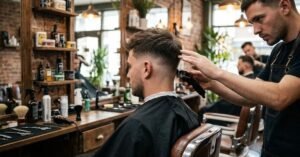
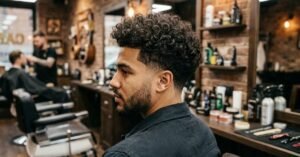
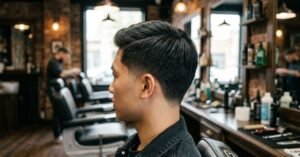
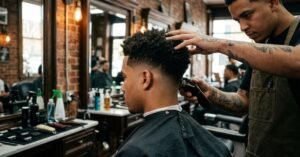
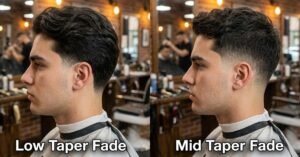
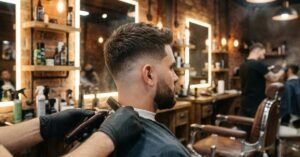
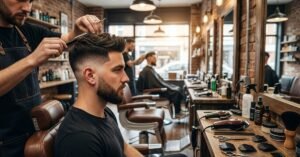
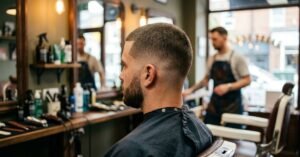
A taper low burst fade combines a gentle taper at the neckline and sideburns with a low fade that curves around the ear in a rounded arc.
The hair behind the ear stays longer, so the back keeps its weight while the sides stay close and clean. It works on short crops, curls, waves, and longer tops, and it looks neat enough for an office yet sharp enough for the weekend.
Because the shape depends on a curved guide line, clear communication with your barber matters as much as the clippers. Below you will find how the cut works, who it flatters, what to ask for, and how to keep it fresh between visits.
What a taper low burst fade is
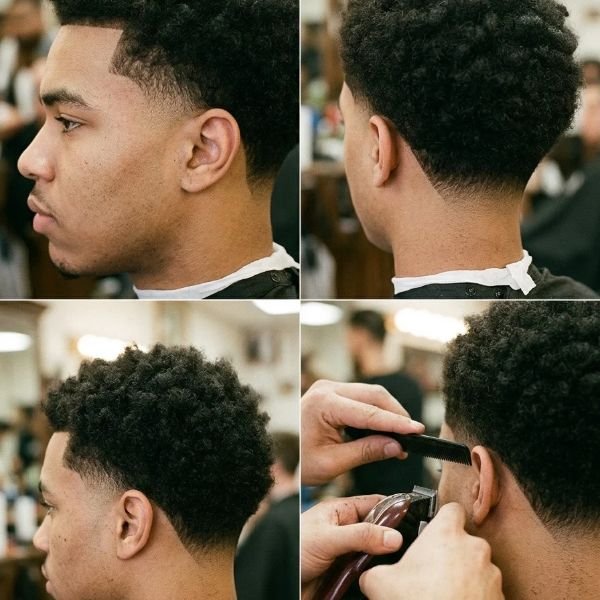
A taper low burst fade is a hybrid haircut. It starts low on the head, near the ear and nape. It blends from short to longer in a smooth gradient. Then it bends into a half-circle around the ear instead of running straight across the back.
Three ideas sit inside the name:
- Taper: The hair gets gradually shorter toward the neckline and sideburns, but it is not cut down to bare skin.
- Low: The blend begins near the ear and the base of the skull, so most of the head keeps its length.
- Burst: The fade curves around the ear like a burst of short hair, leaving longer hair behind it.
The burst shape is what makes this cut recognisable. A barber uses clippers with different guards. A guard is a plastic comb that attaches to the clipper blade and sets the cutting length, numbered from #0 (bare) to #8 (about one inch). The curved fade is built by sweeping through these guard sizes in an arc instead of a straight line.
Taper vs low fade vs burst fade
People mix these terms up, and so do some barbershops. The cut is easier to order once you know what each part does.
Taper

A taper shortens the hair gently along the sideburns and the back of the neck. It leaves more length than a fade and does not expose much scalp. It is the most conservative of the three, which is why it appears in business and school settings.
Low fade
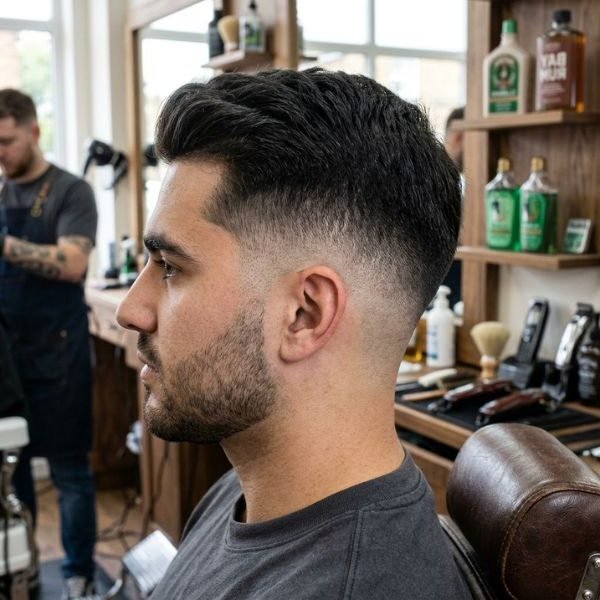
A low fade starts just above the ear and follows the hairline down. It goes shorter than a taper, often to bare skin, and the contrast between short and long is more visible. The fade stays low, so the top and upper sides keep their length.
Burst fade
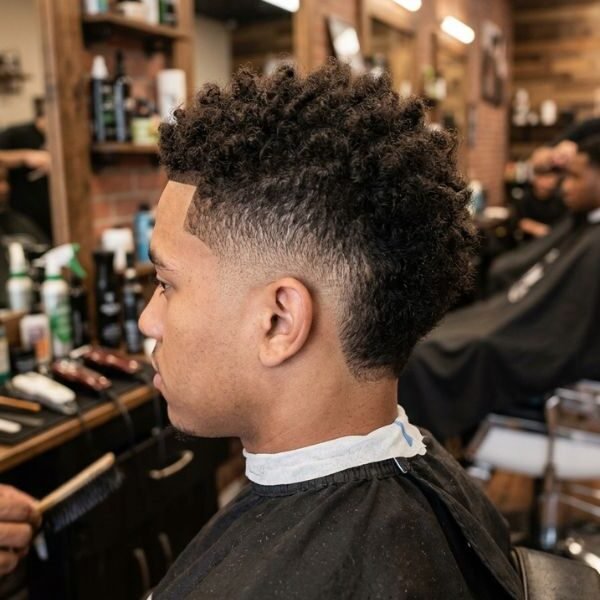
| Feature | Taper | Low fade | Burst fade |
| Starting point | Neckline and sideburns | Just above the ear | Curved around the ear |
| Shortest length | Short but not bare | Often skin level | Short near ear, longer at the back |
| Contrast | Subtle | Medium to high | Medium, with a distinct curve |
| Maintenance | Low | Medium | Medium to high |
| Best known for | Clean, classic look | Sharp, modern look | Rounded, stylised shape |
Who a taper low burst fade suits
This cut is flexible, but it is not identical on everyone. Face shape and hair texture change how it looks.
Face shapes
The curve around the ear changes how the head looks from the side and the back, so face shape matters.
- Oval: Almost every length works. This is the easiest face shape to cut.
- Round: Keep more height on top and keep the sides tight. The burst adds a vertical line that lengthens the face.
- Square: The rounded curve softens a strong jawline. Pair it with a textured top.
- Long or rectangular: Avoid too much height. A shorter, flatter top keeps the face from looking longer.
- Heart-shaped: A fuller top balances a narrow chin, and the low burst keeps the sides from looking too wide.
Hair types
Hair texture decides how easily the fade shows and how long it lasts.
- Straight hair: The blend shows clearly, but gaps look obvious if the barber rushes. Ask for a clean transition.
- Wavy hair: The longer back sections hold the wave pattern, so the burst looks natural.
- Curly hair: This is where the cut shines. The contrast between tight sides and defined curls on top looks deliberate. Barbers often cut curls dry so they can see how each curl sits.
- Coily or 4C hair: A low burst works well because the curve is visible even when the hair is very short. It also pairs well with 360 waves, a wave pattern that spirals around the head, and a crisp line-up, also called an edge-up, which is a straight outline cut along the forehead and temples.
- Thin hair: A low taper keeps density where it matters. Avoid very high contrast, which can make the top look sparse.
Best styles to ask for
The taper low burst fade is a base. The top can change completely, so the look can be quiet or loud depending on what you pair it with.
Here are the combinations that work best:
- Textured crop: A short, choppy top with a low burst. It is easy to maintain and looks current.
- Curly top: Defined curls on top with tight sides. It works well for medium to tight curl patterns.
- Faux hawk: The burst frames a central strip of longer hair. It is the boldest option.
- Side part: A neat part with a low taper. It is the best choice for work and formal events.
- Quiff: The front is swept up and back, which adds height. A pomade or clay helps it hold.
- Waves: Brushed 360 waves on top of a low burst. The fade stays low to preserve length for the wave pattern.
- Longer top with a taper: A mid-length top with the burst keeping the sides neat.
Choose based on how much time you want to spend in front of the mirror. A textured crop takes about two minutes. A quiff or a wave routine takes longer.
How to ask your barber for it
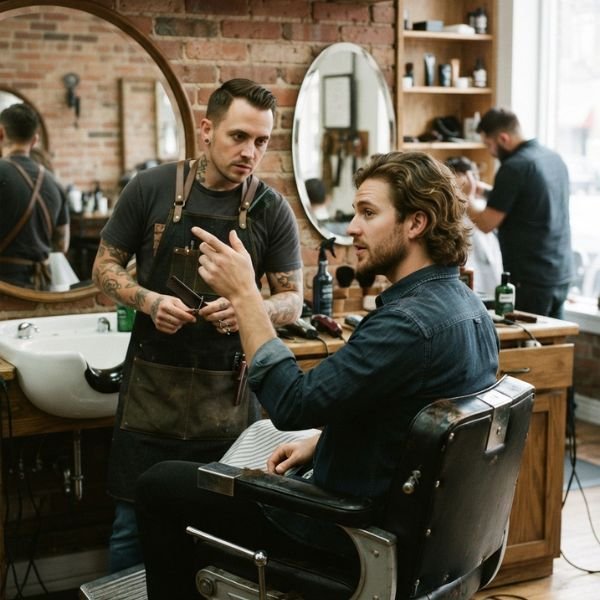
Many bad fades come from vague instructions. Barbers cannot read minds, and “taper fade” means different things in different shops.
A script that works
Use plain words and mention length, position, and shape. Here is a script you can adjust:
“I would like a low burst fade with a taper at the neckline. Start the fade low, just above the ear, and curve it around the ear. Keep the hair behind the ear longer. Take the sides down to a number 1 at the shortest, and leave the top about two to three inches. Keep the sideburns tapered, not bare.”
You can also swap in terms that matter for you:
- Shortest guard: Ask for #0, #1, or #2 depending on how much skin you want to show.
- Top length: Give it in inches or by a finger width.
- Line-up: Say yes or no. A line-up sharpens the forehead and temples but needs more upkeep.
- Beard: If you wear one, ask the barber to blend it into the fade.
What to show
Photos beat words. Bring two or three pictures from different angles: front, side, and back. The back view matters for a burst, because that is where the curve is most visible. If your hair texture differs from the photo, tell your barber. A burst on straight hair will not look the same on curls, and a good barber adjusts the plan to fit.
Keeping a taper low burst fade sharp
Fades grow out quickly because the contrast between short and long is the whole look. Small habits keep the shape clean.
Touch-up timeline
| Goal | Visit interval | What you get |
| Razor-sharp look | Every 2 to 3 weeks | Crisp edges and a clear curve |
| Standard upkeep | Every 3 to 4 weeks | Clean shape with slight softening |
| Relaxed upkeep | Every 5 to 6 weeks | Blend softens, curve is less visible |
Neckline and sideburn cleanup

The neckline and sideburns are the first areas to look untidy. A few quick habits help between appointments:
- Use a small trimmer to clean stray hairs on the nape. Trim only the loose hairs and leave the outline to your barber.
- Keep the sideburns level. Look in the mirror from the front and check that both sides end at the same point.
- Avoid shaving the curve yourself. The burst depends on an exact line, and one wrong pass is difficult to correct.
- Ask your barber to teach you where the line sits so you know what to leave alone.
Mistakes that ruin the cut
Most disappointing fades come from a handful of avoidable errors.
- Asking for a “fade” without a height: Without “low”, you may leave with a mid or high fade.
- Skipping reference photos: Words like “burst” mean different things to different barbers.
- Cutting the top too short: A burst looks best when the top has enough length for contrast.
- Over-cleaning the neckline at home: This can create a hard line that breaks the taper.
- Using too much product: Heavy gel flattens the shape and hides the fade.
- Waiting too long between cuts: The blend grows out and the curve disappears.
- Not telling the barber about cowlicks: A cowlick is a patch of hair that grows in a different direction. It can pull the fade off balance if the barber does not plan for it.
Styling it at home
The cut does most of the styling for you. A short routine keeps it looking deliberate.
- Start with clean, towel-dried hair. Product works better on damp hair than on soaking wet hair.
- Pick the right product. Matte clay gives texture and a flat finish. Pomade adds shine and hold. Sea salt spray adds grip for short, messy tops. Curl cream defines curls without crunch.
- Use a small amount. A pea-sized portion is enough for short hair.
- Shape the top. Push the hair forward, back, or sideways depending on the style you chose.
- Check the sides. The product should stay on top. If it reaches the faded area, wipe it off so the contrast stays clear.
- Wash it out at night. Product build-up dulls the look and clogs pores on the scalp.
For curls, a quick spritz of water and a light diffuse, which means drying the hair gently with a diffuser attachment, keeps the pattern intact.
Taper low burst fade vs blowout taper
| Feature | Taper low burst fade | Blowout taper |
| Main focus | Curved edge around the ear | Volume and shape on top |
| Top length | Short to medium | Medium to long |
| Styling effort | Low to medium | Medium to high |
| Daily tools | Product and comb | Blow dryer and brush |
Is it okay for school, work, or formal settings?
In most cases, yes. A low burst with a taper looks neat and does not expose much scalp, so it passes in conservative settings.
- School: Check the dress code. Most schools allow tapers and low fades. Avoid extreme contrast or shaved designs if rules are strict.
- Office or corporate work: Choose a side part or a short textured top with a soft taper. Keep the burst subtle by leaving the hair behind the ear a bit longer.
- Formal events: A neat, combed top with clean edges works with a suit. A faux hawk is better saved for casual events.
- Creative or relaxed workplaces: You can go bolder with a higher contrast and a textured top.
If you are unsure, ask your barber to make the burst softer. A less visible curve still keeps the taper, and it reads as classic.
Final take
The taper low burst fade works because it balances structure and flexibility. The taper keeps it clean, the low placement preserves length, and the burst gives it a shape that stands out without being loud. It suits most face shapes and hair types, and it adapts to a quiet or a bold top. Success depends on three things: a clear request with photos, a barber who understands the curve, and regular touch-ups every three to four weeks. Get those right and the cut looks sharp from every angle.
Go deeper: low taper fade guides
If you want to build on this cut, these related topics pair well with it:
- Low taper fade for curly hair, including cutting and product tips
- Low taper fade with a beard and how to blend facial hair into the sides
- Low taper fade for waves and how to protect the pattern
- Mid taper vs low taper: choosing the right starting height
- Drop fade vs burst fade: how the curve behind the ear differs
- Haircare routines that keep short sides healthy
Each topic builds on the same basics covered here, so reading them in sequence gives a full picture of how tapers and fades work.
FAQs about the taper low burst fade
What is a taper low burst fade?
It is a low fade that curves around the ear, combined with a taper at the neckline and sideburns. The hair behind the ear stays longer.
Is a burst fade the same as a taper?
No. A taper shortens hair gently, while a burst fade creates a rounded curve around the ear. The taper low burst fade combines both.
How often should I get a taper low burst fade touched up?
Every two to four weeks keeps the curve sharp. Longer gaps soften the blend.
Does a taper low burst fade work on curly hair?
Yes. The tight sides contrast well with defined curls on top, and the curve stays visible.
What should I say to my barber?
Ask for a low burst fade with a taper at the neckline, name the shortest guard, and bring photos of the front, side, and back.
Can I get this cut with a beard?
Yes. Ask the barber to blend the beard into the faded sideburns so the transition looks seamless.
Is it professional enough for the office?
Yes. A soft burst with a side part or short textured top looks neat in most workplaces.
What is the difference between a taper low burst fade and a blowout taper?
The burst fade focuses on the curved edge, while the blowout taper focuses on volume on top.