
A burst fade is a fade that curves in a half circle around the ear instead of running straight around the head. The shortest point sits right behind the ear, and the hair stays longer on top and at the back. It gives the sides a rounded shape that a standard fade does not.
It is easy to get wrong, because the name overlaps with drop fades, tapers and skin fades. A vague request can leave you with a cut that is close but not right.
This burst fade haircut guide explains how the burst works, who it suits and how the low, mid and high versions differ. You will also find five styles to show your barber, a clear request script, styling steps and upkeep timing.
What is a burst fade?
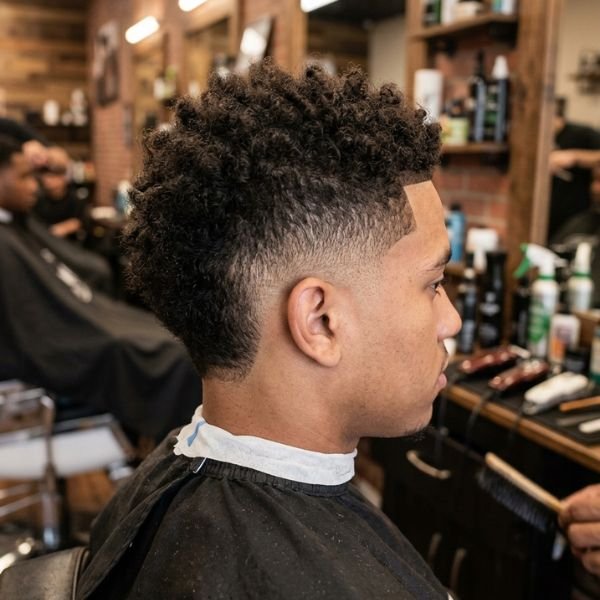
A burst fade haircut is a men’s cut where the sides fade in a semicircle around the ear and curve down toward the neckline. The name comes from the way the fade seems to burst out from behind the ear. You may also hear it called a radial fade or a halo taper.
The fade itself can end in different ways. It can taper softly, go down to the skin, or sit in between. The top is always left longer, which gives the cut its contrast.
How does the burst shape work around the ear?
Think of the ear as the center of a circle. The barber cuts the shortest hair right behind and around the ear. Then the hair gets longer in rings as it moves away.
- At the sideburn: the fade blends into the temple.
- Around the ear: the arc stays tight and curved.
- At the back: the arc ends well before the center of the nape, so a block of longer hair remains.
That curve is what separates a burst from a fade that runs level across the head.
What hair stays longer in a burst fade?
Three areas keep their length:
- The top. It can be a crop, a quiff, a mohawk or curls.
- The center back of the head. The fade curves around the ear and leaves length behind it.
- The neckline. A longer neckline gives you the option of a mullet or a V shape.
That longer back is why a burst suits a flatter back of the head. The extra length adds shape.
Who does a burst fade suit?
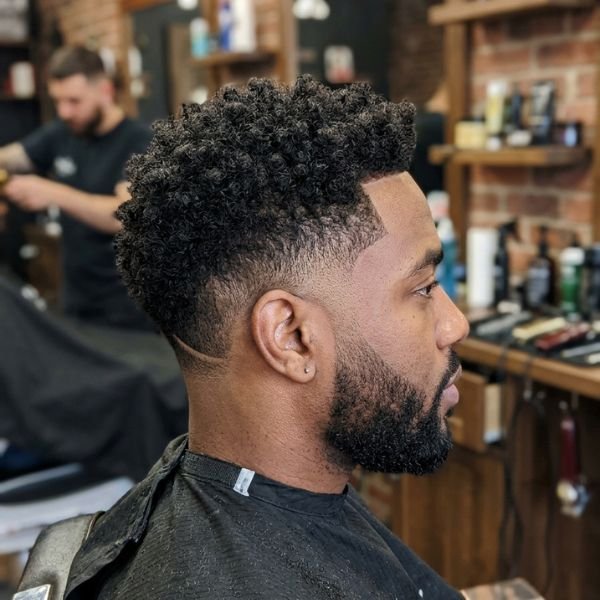
A burst fade haircut suits most men who have at least a medium length of hair on top, and who are happy to visit a barber regularly. It works especially well when you want a bold shape with a neat finish.
Which hair textures work with a burst fade?
- Straight hair: gives clean lines. Add layers so the top does not fall flat.
- Wavy hair: the fade keeps the sides tidy, and the waves stay bouncy on top.
- Curly and coily hair: gives the strongest contrast, because curls stand out against the faded sides.
- Thick hair: point cutting on top removes weight and keeps the shape.
- Fine hair: a shorter top with texture looks denser.
How do head shape, density and lifestyle affect the choice?
Face shape matters less than people think. These three things matter more:
- Head shape: a flatter back of the head gains volume from the length a burst leaves behind. A rounded back needs less.
- Hair density: thin hair on top can look patchy with a very high, bare skin burst. A softer blend looks better.
- Lifestyle: if you cannot visit the barber every two to three weeks, choose a low burst or a taper finish.
Low vs mid vs high burst fade: which should you choose?
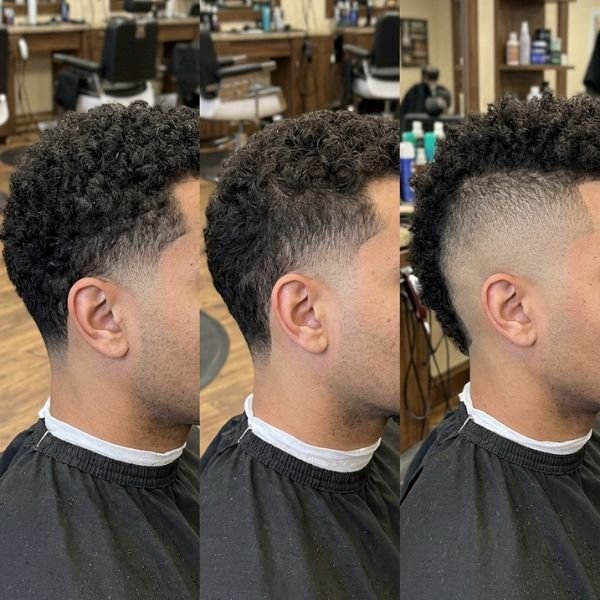
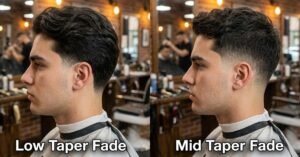
The height is where the arc starts to rise on the side of the head. Pick based on how much contrast you want.
What is a low burst fade?
The arc stays close to the ear and hairline. The contrast is subtle. It is the best choice for offices, first time tries and people who want a longer gap between trims.
What is a mid burst fade?
The arc sits about halfway up the side of the head. It gives clear shape without looking extreme. This is the height most people ask for.
What is a high burst fade?
The arc climbs toward the crown. The contrast is strong and the top looks fuller. It needs the most frequent trims, and it can look patchy on light or fine hair.
Read more: Hispanic Low Taper Fade Styles (Clean & Modern Guide)
Best burst fade styles to show your barber
Choose one or two, then bring photos from the front, side and back.
1. Burst fade mullet

The sides burst around the ear, and the back stays long. It blends a neat fade with a modern mullet. Tell your barber how many inches you want to keep at the back.
2. Burst fade mohawk or faux hawk
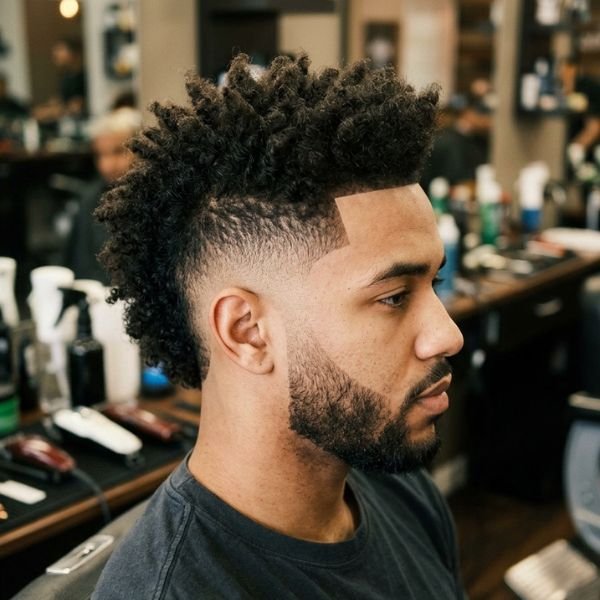
The sides are short, and a strip of longer hair runs down the center. Style it up for a faux hawk or push it forward for a softer look. A little strong pomade or clay holds the shape.
3. Curly or coily burst fade

Curls stay at 2 to 3 inches on top. The fade controls the width at the sides. Ask for the curls to be cut dry and keep them hydrated with a cream.
4. Short or textured-top burst fade

A short, choppy top sits above a clean burst. It is the lowest effort version and works well for thick or fine hair. Matte clay gives the best texture.
5. Straight or wavy burst fade

A quiff, brush up or side swept top suits straight and wavy hair. The burst frames the top without taking attention from it.
Burst fade vs drop fade, taper fade and skin fade
These are often mixed up. They describe different things.
Burst fade vs drop fade

A drop fade dips lower behind the ear and looks more angular. A burst fade curves in a rounder arc. Check behind the ear to tell them apart. A burst is also often paired with round or wide faces, while a drop fade often suits oval and longer faces.
Burst fade vs taper fade

A taper shortens the sideburns and neckline gradually. A burst does the opposite at the back, because it leaves the neck longer. Choose a taper for a quieter cut.
Burst fade vs skin fade
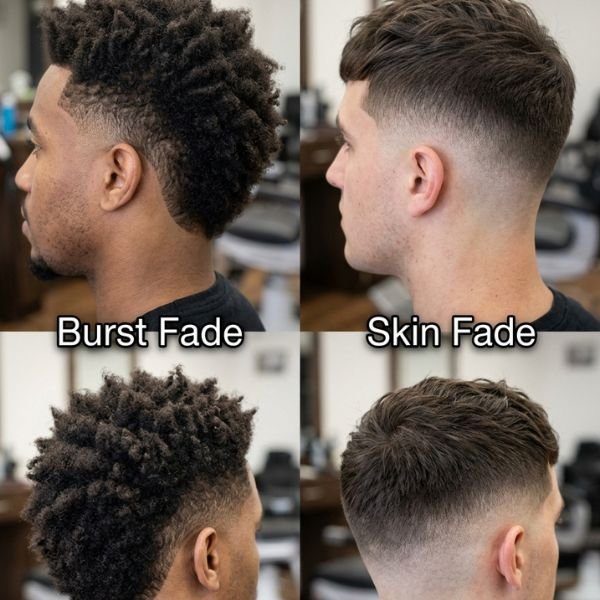
A skin fade describes how short the fade ends, which is down to bare skin. A burst describes the shape of the fade. You can have a skin burst, or a burst blended with a guard.
How to ask your barber for a burst fade
Barbers cut the sides and back, and a front selfie hides both. A clear brief fixes that, and it is the best way to get the burst fade haircut you pictured.
Use a five-point barber brief
- Name the cut and the height: “A burst fade, mid height.”
- Say how close it goes: “Down to the skin,” or “blended with a guard.”
- Give the top length: “About 2.5 inches, with texture.”
- Confirm the neckline: “Keep the length at the back,” or “a natural taper.”
- Add finishing details: “A clean line up along the hairline.”
What should your reference photo show?
Bring three photos if you can: front, side and back. The side shows the arc, and the back shows how much hair stays long. Choose someone with a similar hair type. Point out which part you like.
Read more: Low Fade Haircuts for Black Men: Styles, Tips and Ideas
What are the most common miscommunications?
- “Just a fade.” The barber may give you a straight fade, not a burst.
- No height. Low, mid and high look very different.
- Skipping the neckline. The long back can get trimmed away.
- Mixing up drop and burst. Show a photo from behind the ear.
- No top length. Say it in inches.
How do you style a burst fade?
A burst fade haircut holds its shape, so daily styling is only about the top.
- Towel dry until your hair is damp.
- Apply sea salt spray or light mousse.
- Blow dry in the direction you want, with your fingers.
- Warm a small amount of product in your palms.
- Work it through from back to front.
- Stop early. A slightly messy finish looks more natural.
Styling by hair texture and top style
- Straight hair: texture powder at the roots for lift, then a matte paste.
- Wavy hair: a light cream or sea salt spray, then air dry.
- Curly hair: a curl cream on damp hair, then diffuse or air dry. Avoid heavy gel.
- Faux hawk or mohawk: a strong pomade or wax to hold the center.
- Textured crop: matte clay and a little spray.
- Quiff: blow dry upward, then use clay or cream for hold.
How long does a burst fade last, and how do you maintain it?
Plan on a visit every 2 to 4 weeks, usually around three. Regrowth starts to show around two weeks, and the curve blurs by week three or four.
Touch-up timing and grow-out
- High burst or skin finish: every 2 to 3 weeks
- Low or mid burst with a guard blend: every 3 to 4 weeks
- Line up: every 2 to 3 weeks if you like crisp edges
Hair grows about half an inch a month, so a skin burst has roughly an inch of regrowth behind the ear after two months. The fade grows out evenly, but it loses its shape.
Read more: French Crop Low Taper
Scalp and skin care for very close or skin bursts
When the sides go to bare skin, the scalp is exposed. A few habits help:
- Moisturize after washing, to avoid dryness and flaking.
- Wear sunscreen or a hat in strong sun.
- Do not pick at razor bumps or ingrown hairs.
- If bumps or irritation do not clear up, see a dermatologist.
Is a burst fade right for you?
Main benefits
- Shape: the curve makes the cut look designed.
- Contrast: the top stands out against the faded sides.
- Variety: it works with a mullet, mohawk, crop, curls or a quiff.
- Easy daily care: only the top needs styling.
Trade-offs and edge cases
- Upkeep: it needs regular trims to stay sharp.
- Not for very short hair: it needs medium to longer hair on top.
- Higher bursts need confidence: the contrast is bold.
- Barber skill matters: a poor blend around the ear shows quickly.
What are the best alternatives to a burst fade?
If a burst fade haircut is not quite right, try one of these:
- Burst taper: the same curve with a softer, gradual blend.
- Taper fade: a quieter option that does not leave the back long.
- Drop fade: a more angular curve that suits oval and long faces.
- Low fade: a straight line around the head, with less shape.
Burst fade FAQs
What is a burst fade haircut?
It is a fade that curves in a half circle around the ear, with the top and back left longer.
What is the difference between a burst fade and a drop fade?
A burst curves in a round arc, while a drop fade dips lower behind the ear and looks more angular.
Is a burst fade a skin fade?
Not always. A burst describes the shape, and it can end at the skin or blend with a guard.
How often should I get a burst fade trimmed?
Every 2 to 4 weeks, usually around three. High or skin bursts need trims sooner.
Does a burst fade work on curly hair?
Yes. Curls stand out against the faded sides, and the burst controls the width.
Does a burst fade suit short hair?
Only if there is enough length on top. Medium or longer hair works best.
How do I ask my barber for a burst fade?
Name the cut, the height, how close it goes, the top length and the neckline, then show photos from three angles.

2 thoughts on “Burst fade haircut: what it is, types, styles and barber guide”