
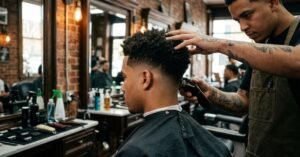
Curly hair has natural volume, bounce, and texture that most other hair types simply do not have. That volume looks great on top, but it can turn into a bulky, shapeless mess on the sides if it is left to grow out freely. This is exactly why a fade works so well with curls. A fade trims the sides and back down in a clean, gradual line while your curls stay full and expressive on top.
If you are trying to decide between a low fade and a low taper fade, or you are simply not sure which fade suits your curl pattern, this guide breaks it down in plain language. You will learn the real difference between a low fade and a low taper, see the best styles for each, understand which option fits your hair type, and get a simple script to use with your barber so you leave the chair with exactly what you asked for.
Read more: Low Taper Fade Without Beard: Styles, Tips and Everything You Need to Know
Why a Fade Works Well for Curly Hair

Curly hair grows outward before it grows down. That is just how the curl pattern behaves, whether you have loose waves or tight coils. Without any shaping on the sides, this outward growth creates a triangle-like silhouette that looks wider at the bottom and can hide the shape of your face.
A fade solves this in three ways.
- It removes bulk. Cutting the sides shorter takes weight off the head, so the curls on top do not have to compete with a mountain of hair below them.
- It defines your face shape. A clean fade line frames your jaw, cheekbones, and hairline instead of letting hair blur those edges.
- It makes curls easier to manage. Less hair on the sides means less time detangling, less frizz buildup around the ears and neck, and a shorter drying time after a wash.
Barbers who specialize in textured hair often describe curly fades as a way to “let the top do the talking.” The sides stay controlled and neat, while the curls get to be the main feature of the haircut. This is also why fades have become one of the most requested cuts for curly hair in recent barbershop trends, regardless of whether the curl pattern is loose 2C waves or tight 4C coils.
What Is a Low Fade for Curly Hair?

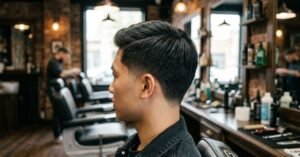
A low fade is a fade that starts close to the bottom of the head, usually just above the ears and around the nape of the neck. Unlike a mid fade or high fade, which begin higher up near the temples or the crown, a low fade keeps the shorter section confined to a narrow band at the base.
For curly hair, a low fade means:
- The bulk of your curls stays untouched higher up on the sides and on top.
- Only the lowest section, where hair meets skin, is cut down to a very short length or skin level.
- The transition from short to long happens over a shorter distance, so it looks more subtle from a few feet away.
This makes the low fade one of the more conservative fade options. It works well for office environments, school settings, or anyone who wants a clean look without a dramatic contrast between the sides and the top. It is also a forgiving choice for first-timers who are nervous about a bold fade, since it leaves more length as a safety margin if the cut needs adjusting.
Read more: High Taper Fade
What Is a Low Taper Fade for Curly Hair?

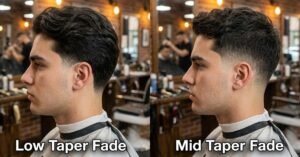
A low taper fade is often confused with a low fade, but there is a technical difference. A true fade blends hair all the way down to bare skin at some point. A taper, on the other hand, gradually shortens the hair without ever fully exposing the scalp.
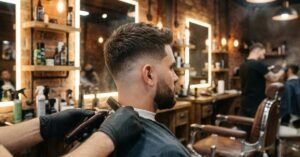
A low taper fade combines both ideas. It starts low on the head, like a low fade, but instead of cutting straight down to skin, the barber uses clippers with graduated guard sizes (often moving from a size 2 or 3 down to 1 or 0.5) to soften the blend. The result is a gentler transition that still looks sharp but avoids the hard, high-contrast line you get from a full skin fade.
For curly hair specifically, this softer blend matters. Tight curls and coils already create natural texture and shadow along the hairline, so a low taper fade tends to look cleaner for longer as it grows out, since there is no stark bald line to lose its crispness.
Low Fade vs Low Taper – Simple Difference
| Feature | Low Fade | Low Taper Fade |
|---|---|---|
| Where it starts | Low, near the ears and nape | Low, near the ears and nape |
| How short it gets | Often down to bare skin | Shortens gradually, rarely to bare skin |
| Contrast level | Higher contrast, sharper line | Softer, more gradual blend |
| Regrowth appearance | Shows regrowth faster | Grows out more evenly |
| Best for | Bold, defined edges | Natural, low-maintenance look |
Best Low Taper Fade Styles for Curly Hair
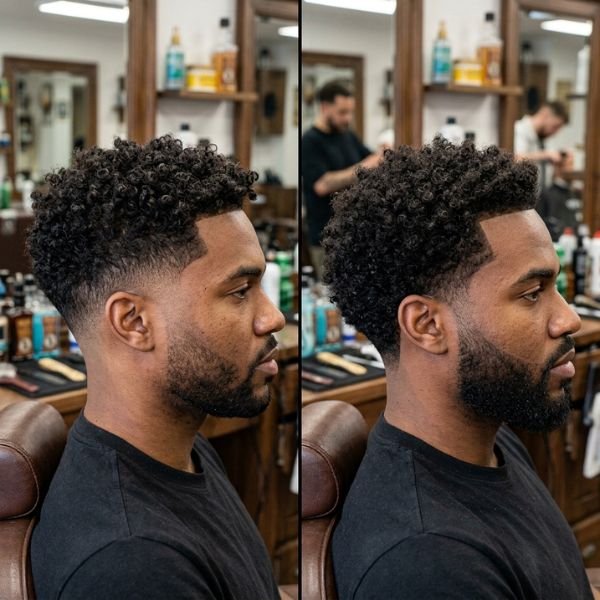
A low taper fade tends to suit people who want their curls to be the main focus without a sharp contrast pulling attention to the sides.
- Low taper with a curly crop. Short, dense curls on top paired with a soft taper on the sides create a neat, low-effort daily style.
- Low taper with a textured quiff. The top is left long enough to push upward and back, giving height while the taper keeps the sides quiet and controlled.
- Low taper with a curly mullet. Length is kept at the back while the low taper handles the sides, giving a bold but balanced silhouette.
- Low taper with a side part. A defined part is combed into the curls on top, giving a slightly more formal finish that still works with natural texture.
Low Taper for 3C / Coily Hair

3C curls and coilier hair types (often grouped near the 4A/4B/4C range) hold their shape differently than looser 2A to 2C waves. Because the curl pattern is tighter, the hair naturally shrinks upward and outward, which means it can look shorter than it actually is when it dries.
For 3C and coily hair, a low taper fade generally works better than a hard low fade for a few practical reasons.
- It hides shrinkage better. Since the taper does not cut all the way to skin, there is less visible contrast if your curls shrink up after washing.
- It reduces bumps around the fade line. Coily hair can sometimes cause small texture bumps at a hard fade line. A gradual taper minimizes this by not forcing an abrupt length change.
- It grows out more gracefully. Coily hair already disguises regrowth well, and pairing that with a soft taper (instead of a sharp fade) stretches the time between barber visits even further.
A barber experienced with coily and kinky textures will usually recommend keeping the taper slightly higher up on the sides (just above the ear) with a size 1 or 1.5 guard, then blending down to a 0.5 near the nape, rather than going straight to bare skin.
Read more: Kids And Teen Fade Hairstyles: A Simple Guide for Modern Boys
Choosing the Best Fade by Hair Type
Not every curl pattern behaves the same way under clippers, so the “best” fade really depends on your specific hair type.
- Loose waves (2A to 2C): A low fade with more contrast tends to look sharper here, since looser waves show off a defined line well.
- Springy curls (3A to 3B): Either a low fade or a low taper fade works, but a low taper is a safer everyday choice because it grows out more evenly.
- Tight curls and coils (3C to 4C): A low taper fade is usually the better long-term option, for the shrinkage and regrowth reasons explained above.
- Thick or dense curly hair: A fade helps remove serious bulk from the sides, since dense curls carry more weight and volume than fine or medium hair.
- Fine curly hair: A low taper is often gentler here, since it avoids stripping away too much hair on the sides, which can make fine curls look thin by comparison.
Best Fade for Daily Life

If you need one answer for the busiest schedules, a low taper fade paired with a moderate amount of length on top (around two to four inches) is usually the most practical everyday choice for curly hair. It needs less frequent barber visits than a skin fade, it hides regrowth better, and it works with a simple wash-and-go or diffuse-dry routine without demanding a lot of daily styling.
How to Tell Your Barber
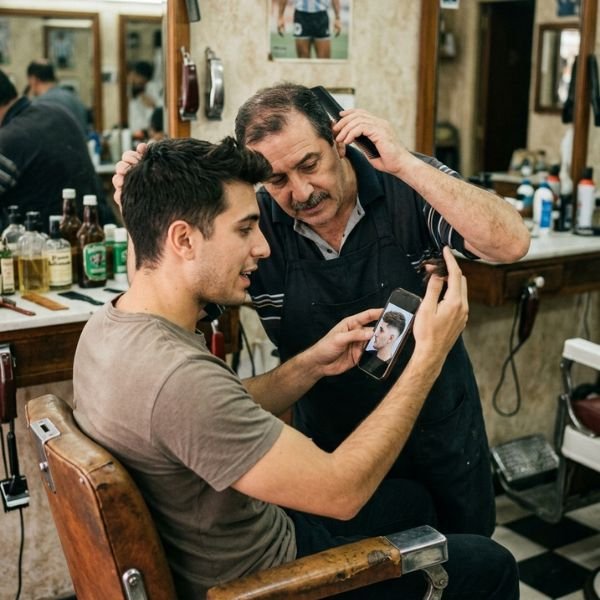
Miscommunication is the most common reason a fade does not turn out the way someone pictured. Curly hair also behaves differently once it is wet versus dry, so being specific matters more than it does with straight hair.
A clear way to describe what you want:
- Name the fade type: “I want a low fade” or “I want a low taper fade,” not just “a fade.”
- Give a guard number if you know one, such as “start with a 2 on the sides, blend to skin (or to a 0.5) at the bottom.”
- Mention your curl pattern, for example “my curls are tight, around a 3C to 4A texture.”
- Say how much length you want kept on top, in inches if possible.
- State your maintenance goal, such as “I want this to grow out cleanly for four weeks.”
Avoid
- Vague phrases like “just clean it up” or “you know what looks good,” since these leave too much room for interpretation.
- Asking for a fade while your hair is fully dry and shrunken, since this can lead to more length being cut than you actually wanted once the curls stretch out.
- Sitting down with a photo of straight hair and expecting the same fade line to translate directly onto a curly texture.
Tip:
Come in with your hair in its natural, freshly washed curl state rather than freshly straightened or heavily product-laden. This lets your barber see exactly how your curl pattern falls and shrinks, so the fade height and blend are judged accurately.
Show a picture to make it clear.
Words describe a fade reasonably well, but a photo removes almost all ambiguity. Save two or three reference images of curly hair (not straight hair) with the fade height, curl length, and blend style you want, and show them at the start of the appointment, before any cutting begins.
Maintenance Tips:
- Book touch-ups every two to four weeks. Low fades and low taper fades hold their shape a bit longer than skin fades or high fades, but regrowth still needs regular attention.
- Clean up the neckline and sideburns yourself between visits. A trimmer or detailer can keep these edges sharp for a week or two past a normal touch-up point.
- Deep condition regularly. Curly hair loses moisture faster than straight hair, and dry curls look duller and frizzier against a clean fade.
- Use a lightweight curl cream or gel, not heavy pomade. Heavy products weigh curls down and can make them look flat instead of defined.
- Sleep on a satin or silk pillowcase, or use a satin bonnet. This cuts down on friction overnight, which reduces frizz and helps curls keep their shape between washes.
- Avoid over-washing. Washing curly hair two or three times a week, rather than daily, helps it hold natural oils and keeps curls looking defined.
- Diffuse-dry instead of rough-towel-drying. A diffuser attachment on a blow dryer, used on low heat, encourages curls to form properly instead of frizzing out.
Final Summary:
Curly hair and fades work well together because the fade takes care of bulk and shape on the sides while your natural curls stay front and center on top. A low fade gives a sharper, higher-contrast finish that suits looser waves and bolder styles, while a low taper fade offers a softer blend that grows out more gracefully, which makes it the better everyday pick for tighter curls, coils, and anyone who wants lower-maintenance upkeep. Whichever you choose, clear communication with your barber, using the right guard numbers, curl description, and a reference photo, is what actually determines whether you walk out with the cut you pictured.
Frequently Asked Questions
Is a low fade good for curly hair?
Yes. A low fade removes bulk from the sides while keeping most of your curl length intact, which suits most curl patterns and face shapes well.
Is a low taper fade better than a low fade for curly hair?
For tighter curls and coils, a low taper fade is usually better since it blends more gently and shows less obvious regrowth over time.
How often should I get my curly fade touched up?
Most low fades and low taper fades need a touch-up every two to four weeks, depending on how fast your hair grows.
Will a fade make my curls look thinner?
No. A fade only shortens the sides and back, so the curls on top keep their full volume and definition.
Can 4C or coily hair get a low fade?
Yes, though a low taper fade is often recommended for very coily hair since it hides shrinkage and grows out more evenly than a hard skin fade.
Do I need special products for a curly fade?
A lightweight leave-in conditioner and a curl cream or light gel are usually enough. Heavy pomades can weigh curls down and flatten their shape.
Should I get my fade cut when my hair is wet or dry?
Come in with clean, naturally dried curls rather than fully straightened hair, so your barber can see your true curl pattern and shrinkage before cutting.
What is the difference between a fade and a taper in simple terms?
A fade blends hair down to bare skin at some point, while a taper only shortens the hair gradually without ever exposing the scalp completely.

1 thought on “Best Fades for Curly Hair – Easy & Complete Guide”