
A low taper fade buzz cut keeps the hair short all over and gradually shortens it around the ears and neckline, starting low and ending close to the skin. It gives you the ease of a clipper cut with a cleaner, more tailored finish than a flat buzz.
Results depend on three choices: the guard length on top, how far down the taper reaches, and how crisp the edges are. This guide covers those choices in plain terms, including clipper guard sizes, hair type adjustments, face shape matches, barber wording, and upkeep schedules.
Use it to walk into the chair knowing exactly what to ask for and how to keep the cut sharp between visits.
What is a low taper fade buzz cut?

Quick answer: A low taper fade buzz cut is a short, even clipper cut on top with sides and back that blend from slightly longer to very short, beginning near the ear and sideburn and finishing at the nape.
The idea that holds everything together is contrast. The top stays uniform, while the edges soften into the skin. That small shift makes a basic buzz look planned instead of plain.
Why the starting point matters
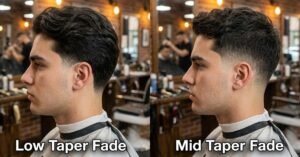
The “low” in the name describes where the blend begins. On a low taper, the shortest part sits around the top of the ear and curves behind it to the neckline. Very little of the head is faded.
That placement has real effects:
- It keeps most of the side hair at the buzz length, so the cut looks conservative.
- It works well in offices, schools, and uniformed jobs.
- It grows out gently, because the change in length is small.
- It adds shape without changing the head silhouette much, unlike a high fade.
What a taper adds that a plain fade doesn’t
Barbers use “taper” and “fade” loosely, so the terms overlap. In practice, a fade usually blends all the way down to bare skin and makes a bold, visible gradient. A taper shortens the hair more gently and often stops at a short stubble length instead of skin.
A low taper fade buzz cut combines both ideas. The blend is subtle, but it can still finish at a close or skin level at the very bottom if you ask for that. If you want to read more about how these terms developed, the buzz cut entry on Wikipedia gives useful background on the cut’s military origins.
Best low taper fade buzz cut styles

The same base cut can look quite different depending on top length, edges, and extras. These are the most requested versions in 2026.
- Classic uniform buzz: One guard length on top, usually a number 2, with a clean low taper at the sides. It is the safest option for first-timers.
- Longer crop buzz: A number 4 to 6 guard on top for a softer, slightly textured look. It suits people who find a very short buzz too severe.
- Low taper skin fade buzz: The taper drops to bare skin at the base. It looks sharper and needs more frequent visits.
- Buzz with a hard part: A thin razor line cut into the side of the hair. It adds a clear focal point without adding length.
- Buzz with a beard fade: The sideburn taper connects into a trimmed beard so the cut and beard look like one design.
- Waves buzz: A very short top, often a number 1 or 2, brushed to show wave patterns, with a low taper at the edges.
- Low taper with a sharp line-up: A crisp edge at the forehead and temples that makes the buzz look freshly cut for longer.
If you are unsure, start with the classic version. You can always ask for more contrast next time.
Choosing your buzz length: a clipper guard guide

| Guard number | Length | What it looks like |
| 0.5 | 1.5 mm (1/16 in) | Almost skin, a close shadow |
| 1 | 3 mm (1/8 in) | Very short, scalp clearly visible |
| 2 | 6 mm (1/4 in) | Classic buzz, the most popular choice |
| 3 | 9.5 mm (3/8 in) | Soft buzz, scalp barely visible |
| 4 | 12.5 mm (1/2 in) | Short crop, hair starts to show texture |
| 5 | 16 mm (5/8 in) | Longer crop, easy to style |
| 6 | 19 mm (3/4 in) | Short crew, clear hair texture |
- Strong hairline or great head shape: Choose a number 1 or 2.
- Thinning hair or receding temples: Choose a number 2 or 3, which makes the density look more even.
- Dense hair that you want to look softer: Choose a number 4 or 5.
- First buzz cut ever: Start longer than you think. You can always go shorter, but you cannot add length back.
For the taper itself, a typical build is a number 2 on top, a number 1 blended around the ears, and a number 0.5 or trimmer finish at the nape. Your barber may adjust this to match your hair growth pattern.
Read more: French Crop Low Taper
Low taper fade buzz cut for straight, wavy, curly, and coily hair
Hair texture changes how a buzz looks, how the taper shows, and how fast it grows out.
Straight hair

Straight hair shows the scalp more at short lengths and makes the taper look very clean. Cowlicks, especially at the crown, can stand up at number 3 or longer. A slightly shorter guard usually solves that.
Wavy hair

Wavy hair adds light texture even when cut short. At a number 3 or 4 you will see soft movement on top, which looks relaxed against a tight taper.
Curly hair

Curly hair shrinks when cut, so it appears shorter than it is. The taper shows well, and a number 3 or 4 usually keeps curl definition on top while the sides stay neat.
Coily hair

Coily hair holds crisp lines very well, so line-ups and tapers look especially sharp. Many people with this hair type also like a number 1 or 2 with a brush for waves.
Because tightly coiled hair can curl back into the skin after cutting, razor bumps are possible. The American Academy of Dermatology explains how to treat and prevent razor bumps, including using a clean, sharp blade and avoiding very close shaves if irritation occurs.
Read more: Burst fade haircut: what it is, types, styles and barber guide
Best low taper fade buzz cut for your face shape

| Face shape | Best top length | Taper tip |
| Oval | Number 1 to 4 | Almost anything works, so choose by taste |
| Round | Number 2 to 4 | Keep the taper tight to add definition |
| Square | Number 1 to 3 | A low taper keeps the strong jaw as the focus |
| Oblong | Number 3 to 5 | Avoid very short sides that lengthen the face |
| Heart | Number 2 to 4 | Low taper keeps balance, so avoid a high fade |
| Diamond | Number 2 to 3 | A slight beard fade can balance wide cheekbones |
Line-ups and shape-ups: getting the edges right
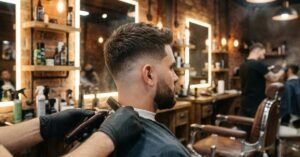
A line-up, also called an edge-up or shape-up, uses a trimmer to create a clean line along the forehead, temples, and sideburns. It sharpens the cut and makes a low taper fade buzz cut look finished.
You can usually choose from three edge styles:
- Natural: Follows your real hairline. It is the best option for work and everyday wear.
- Soft: Cleans stray hairs and slightly rounds the corners.
- Sharp: A strong geometric edge with square corners. It looks bold but needs weekly touch-ups.
Some tips for better edges:
- Ask for the line to follow your natural hairline so it does not move too far back.
- If your hairline is receding, choose a natural or soft edge. Sharp lines can exaggerate recession.
- Keep the neckline either rounded, squared, or tapered. A tapered neckline grows out the most gently.
- Ask whether the barber uses a trimmer with a zero gap, which gives the closest line.
How to ask your barber for a low taper fade buzz cut
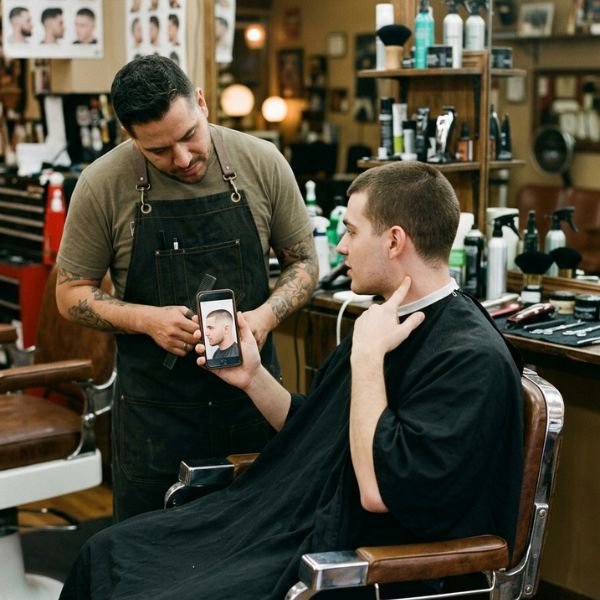
Clear words prevent most haircut disappointments. Follow these steps:
- Say the name of the cut. “Low taper fade buzz cut.”
- Give the top length. “Number 2 on top.”
- Describe the starting point. “Begin the taper just above the ear.”
- Say how short it ends. “Down to a number 0.5” or “to skin at the nape.”
- Choose your edge. “Natural line-up, clean neckline.”
- Bring a photo. A picture from the back and side removes guesswork.
A sample sentence you can use: “I would like a low taper fade buzz cut, number 2 on top, taper starting just above the ear down to a number 0.5, with a natural line-up.”
If you are nervous, ask the barber to start with a longer guard. Most barbers are glad to adjust.
Low taper fade vs mid taper vs skin fade
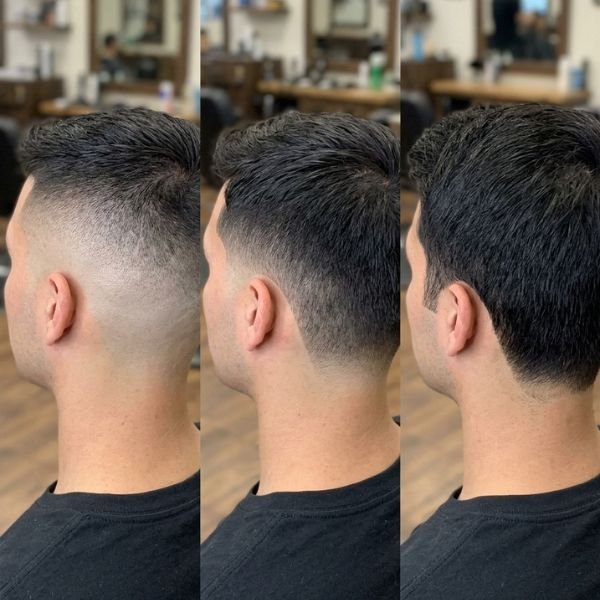
| Feature | Low taper fade | Mid taper fade | Skin fade |
| Blend starts | Around the ear | Around the temple | Varies, ends at bare skin |
| Contrast | Subtle | Moderate | Strong |
| Work friendliness | Very high | High | Medium to high |
| Upkeep | Every 2 to 3 weeks | Every 2 to 3 weeks | Every 1 to 2 weeks |
| Best for | Clean, classic look | Balanced modern look | Bold, sharp look |
How to maintain a low taper fade buzz cut

A buzz cut is easy, but a taper shows growth quickly because the edges lose their shape first. A simple routine keeps it fresh.
Read more: High taper fade haircut: what it is, who it suits, and what to ask for
Barber visits
- Book a visit every 2 to 3 weeks to keep the taper sharp.
- A visit every 3 to 4 weeks works if you prefer a softer look.
- Skin versions look best with visits every 1 to 2 weeks.
Home care
- Wash with a gentle shampoo a few times a week. A buzz cut does not need heavy products.
- Moisturize the scalp with a light lotion or oil if it feels dry, which also helps reduce flaking.
- Protect your scalp from the sun. Short hair gives little cover, so the American Academy of Dermatology advises broad-spectrum, water-resistant sunscreen with an SPF of 30 or higher on exposed skin.
- Use a trimmer for the neckline between cuts, but leave the taper to your barber.
- Brush if you want waves. A soft brush for a few minutes a day trains hair direction.
- Wipe the clippers and trimmers if you cut at home, so skin stays clean.
Home touch-ups work for the top, but blending a taper takes practice. Most people get better results leaving that step to a barber.
Frequently asked questions
What is a low taper fade buzz cut?
It is a short buzz cut with sides and back that blend gradually shorter, starting near the ear and finishing at the neckline.
What guard should I use for a low taper fade buzz cut?
A number 2 on top is the most common choice, with the sides blended from a number 1 down to a 0.5 or trimmer finish.
How often should I get a low taper fade buzz cut?
Every 2 to 3 weeks keeps the taper sharp, though you can stretch it to 4 weeks for a softer look.
Is a low taper fade the same as a low fade?
They are very close. A taper is usually more subtle, while a fade often blends all the way to bare skin.
Does a low taper fade buzz cut suit thinning hair?
Yes. An even short length makes thinning less obvious, and a number 2 or 3 usually looks most balanced.
Can I do a low taper fade buzz cut at home?
You can buzz the top yourself, but blending a clean taper is difficult without practice and a good set of guards.
Is a low taper fade buzz cut professional?
Yes. Its low contrast and tidy edges make it suitable for most workplaces and formal settings.
Does it work on curly and coily hair?
Yes. Curly and coily hair hold tapers and line-ups very well, and a number 2 to 4 on top usually looks best.
How long does it take to grow out?
Most people see the taper lose its shape in about 2 to 3 weeks, and a full grow-out to a longer style takes several months.




1 thought on “Low taper fade buzz cut: styles, lengths, face shapes, and maintenance”