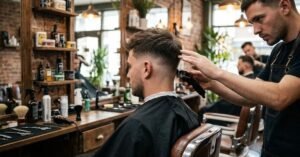
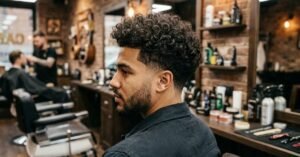
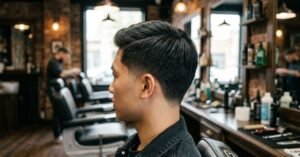
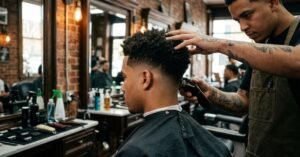
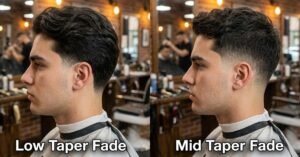
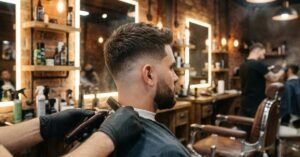
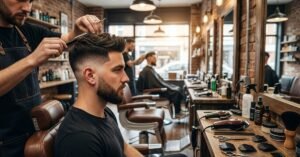
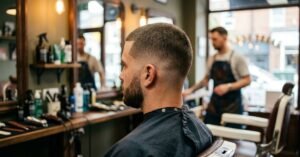
Low mid taper fade haircuts blend short sides into longer hair at a point between the ear and the temple.
That placement gives you cleaner edges than a low taper and a softer finish than a mid fade. It works with short crops, waves, curls, and longer tops, so most men can wear it to the office and the gym without changing a thing.
This guide explains what the cut is, how it differs from nearby fades, which styles and face shapes suit it, and the exact words to use in the barber’s chair.
You will also find home styling steps, trim timing, and common mistakes to avoid in 2026.
What a low mid taper fade actually is
A low mid taper fade is a clipper cut where the sides and back get gradually shorter, and the blend starts at a height roughly halfway between a low taper and a mid taper. On most heads, that is just above the ear and slightly below the temple.
The word “taper” matters here. A taper keeps some length at the very bottom, so the neckline and sideburns stay soft instead of dropping to bare skin. A fade, by contrast, often moves all the way down to skin. This cut sits in between, which is why many barbers describe it as a tidy, grown-out-friendly option.
Here is what defines the cut:
- The blend begins midway between the ear and the temple
- Hair around the sideburns and nape stays short but not bald
- The top keeps its length for texture, volume, or a part
- The transition looks smooth, with no visible lines or steps
Low taper vs mid taper vs low mid

| Cut | Where the blend starts | Contrast level | Best for |
| Low taper | Just above the ear and nape | Subtle | Office wear, first-timers, longer tops |
| Low mid taper | Between ear and temple | Moderate | Balanced, everyday polish |
| Mid taper | At or near the temple | Noticeable | Sharper looks, short hair |
Why it’s everywhere in 2026
Three things keep this cut popular in 2026. First, it grows out gracefully. Because the blend sits low, you can stretch the time between visits without the shape falling apart quickly.
Second, it matches how men dress and work now. Hybrid offices, creative jobs, and casual weekends all reward a haircut that looks neat without looking formal.
Third, it pairs with nearly every top style. Textured crops, curls, waves, quiffs, and even longer flow all sit well above a low mid blend. Social feeds on Instagram and TikTok also show it often because the cut photographs well from every angle, which helps it spread.
Best low mid taper fade styles

The sides stay the same, so the top does the talking. These are the most requested pairings, ordered from shortest to longest on top:
- Crew cut or buzz top: Very low maintenance, with a clean, athletic look.
- Textured crop: Short, choppy layers with a forward fringe. Easy to style with clay.
- French crop: A blunt fringe over a tapered side, good for thinner hair.
- Ivy League or side part: A classic, tidy finish for workplaces and events.
- Slick back: Medium length combed back with pomade for a sharper profile.
- Quiff or pompadour: Extra height at the front, balanced by the soft taper.
- Curly top: Defined curls or twists with a clean, tapered edge.
- Waves with a taper: Brushed waves on top, often finished with a crisp lineup.
- Longer flow: Hair swept back or tucked behind the ears over tidy sides.
A beard also works well with this cut. The blend meets the sideburn smoothly, so the hair and beard look like one connected shape.
Matching the cut to your hair type
| Hair type | What to ask for | Styling tip |
| Straight, fine | Slightly longer top, soft blend | Use a light texturizing spray for lift |
| Straight, thick | Thinned top with a clean blend | Use a matte paste to control bulk |
| Wavy | Medium top, low mid taper | Air dry with sea salt spray |
| Curly | Longer curls, clean sides | Apply curl cream on damp hair |
| Coily (4C) | Sharp lineup, defined taper | Moisturize daily, brush for waves |
Which face shapes it suits
Because the blend is moderate, this cut flatters most faces. A few small tweaks make it even better:
- Oval: Almost any top style works, so choose what fits your routine.
- Round: Add height on top, like a quiff, to lengthen the face.
- Square: The soft taper balances a strong jawline.
- Oblong: Keep the sides a little fuller so the face does not look longer.
- Heart: A textured fringe softens a wider forehead.
- Diamond: Keep some volume on the sides to balance prominent cheekbones.
If you are unsure, ask your barber to adjust the blend height by a half inch. That small shift can change how your face frames the cut.
How to ask your barber for it
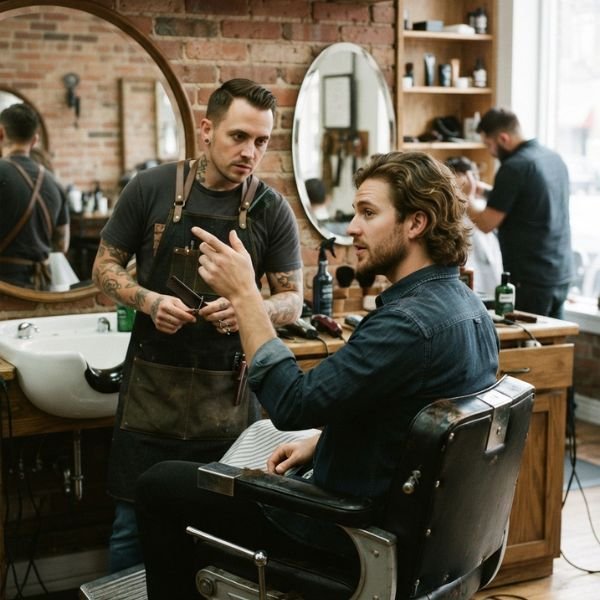
Clear words save you from a surprise. Barbers tend to respond well to specifics, and a photo is the fastest way to align on height. Follow these steps:
- Bring one or two photos that show the side and back view.
- Say “low mid taper fade” and point to where you want the blend to start.
- Name your guard range, for example “start around a number 1 and blend into a number 3 or 4.”
- Tell them how much to leave around the sideburns and neckline.
- Choose the finish: natural taper, skin fade at the very bottom, or a sharp lineup.
- Describe the top length and how you plan to style it.
If you want a softer look, ask for a “scissor taper” on the sides. If you prefer contrast, ask for a skin finish at the base. Mentioning your usual styling routine also helps, because the barber can shape the cut to match.
Styling it at home

A good low mid taper fade needs very little effort. The routine below takes about five minutes:
- Wash with shampoo and conditioner suited to your hair type.
- Towel dry until damp, not dripping.
- Apply a pea-sized amount of product. Use clay or paste for texture, pomade for shine, or cream for curls.
- Blow dry or air dry, shaping the top as you go.
- Finish with a light spray or a small amount of product for hold.
Here are a few products that fit the cut:
- Matte clay for textured crops
- Pomade for slick backs and side parts
- Sea salt spray for waves
- Curl cream for curly and coily hair
- A soft brush for waves and tidy edges
Keep the sides clean with a small trimmer if you have one, but avoid reshaping the fade yourself. Small mistakes around the temples show quickly.
How often to get it trimmed
| Visit frequency | Result |
| Every 2 weeks | Razor sharp edges, crisp blend |
| Every 3 to 4 weeks | Fresh look with natural softness |
| Every 5 to 6 weeks | Grown out, but still presentable |
Mistakes worth avoiding
Even a simple cut can go wrong. Watch for these:
- Asking for “a fade” with no height: The barber has to guess, and the result may be higher or lower than you wanted.
- Skipping reference photos: Words alone are easy to misread.
- Cutting the top too short: The blend looks best with some length to contrast against.
- Ignoring your hair texture: A cut that suits straight hair may need changes for curls.
- Overusing product: Heavy gels can make the top look flat or greasy.
- Waiting too long between cuts: The fade loses shape and starts to look uneven.
- Trying to fix the blend at home: One wrong pass of the clippers is hard to undo.
The short version
A low mid taper fade starts between the ear and the temple, keeps the neckline soft, and leaves enough top length for almost any style.
It is balanced, easy to wear, and flexible across hair types and face shapes. Bring a photo, name the height, pick your guard range, and trim every two to four weeks. Style it with a light product that suits your texture, and avoid rushing the blend at home.
Go deeper: low taper fade guides
If you want more ideas around the same family of cuts, these topics pair well with this guide:
- Low taper fade styles for Black men, including waves, twists, and sharp lineups
- Taper fade mohawk looks for every hair type
- Taper fade mullet variations for longer hair on top
- Quiff hairstyle variations that sit well on a tapered base
Each one builds on the same ideas of blend height, top length, and upkeep, so you can compare options before your next appointment.
FAQs about the low mid taper fade
What is a low mid taper fade?
It is a haircut where the sides and back gradually shorten, starting between the ear and the temple. The result looks clean and balanced.
Is a low mid taper fade the same as a low taper?
No. A low taper starts closer to the ear and nape, while a low mid taper starts a bit higher for more shape.
Is a low mid taper fade professional?
Yes. The soft blend and tidy neckline suit offices, interviews, and formal events.
Does a low mid taper fade work for curly hair?
Yes. The clean sides make curls look fuller and more defined.
How long does a low mid taper fade last?
It looks sharpest for two to three weeks and stays presentable for up to five or six.
What guard numbers are used for a low mid taper fade?
Barbers commonly start near a number 1 or 2 at the base and blend into a number 3 or 4, depending on your preference.
Which face shape suits a low mid taper fade best?
Oval faces are the easiest fit, but the cut also flatters round, square, and oblong faces with small adjustments.
Can I get a low mid taper fade with a beard?
Yes. The blend connects smoothly to the sideburns and beard, creating one continuous shape.
How do I ask for a low mid taper fade?
Show a reference photo, say “low mid taper fade,” and tell the barber where the blend should start and which guard to finish with.