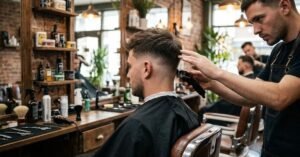
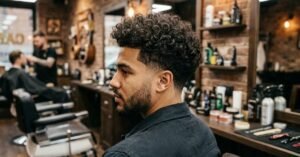
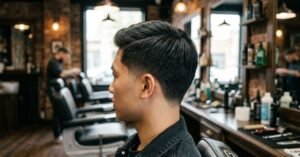
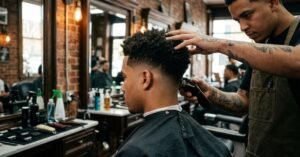
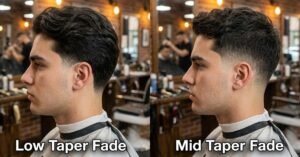
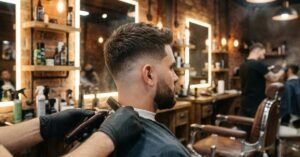
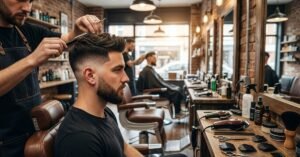
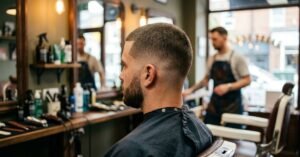
A Hispanic and Mexican low taper fade is a short, clean haircut where the sides and back shrink gradually toward the ears and neckline, while the top keeps length, texture, or curls.
It looks sharp without being extreme, so it works at school, at the office, and on weekends. Hispanic versions lean toward flexible, natural shapes. Mexican versions often add a crisper line-up, a fringe, or a sculpted top.
This guide shows you how both styles differ, which one suits your face and hair, what to tell your barber, and how much upkeep to expect.
What Is a Low Taper Fade?

A low taper fade is a haircut where hair gets shorter in a smooth gradient, but only at the lowest part of the head: around the sideburns, the ears, and the nape.
The “low” means the fade starts just above the ear and does not climb toward the temples. The “taper” means the change in length is gradual, not a sharp jump to bare skin.
A barber measures this gradient with clipper guard numbers. A #1 guard leaves about 1/8 inch of hair, and a #2 leaves about 1/4 inch. Most low tapers end around a #1 or #2 at the bottom, then blend upward.
The cut is subtle, which is why barbers often call it the safest fade. Prose describes the low taper as barely a fade at all, since only the last bit of the style is faded down.
Low taper fades are popular because they:
Here are the main reasons men keep choosing this cut:
- Look neat without needing daily styling
- Work with short, medium, and long hair on top
- Suit most face shapes and hair textures
- Stay presentable longer than higher fades
- Pair well with beards, fringes, and curls
- Fit professional and casual settings
Hispanic Low Taper Fade:

“Hispanic” describes people with roots in Spanish-speaking countries, including Mexico, Colombia, Puerto Rico, Cuba, Argentina, and Spain.
Hair types in this group vary widely, from straight to wavy to tightly coiled. For that reason, a Hispanic low taper fade is less a single haircut and more a flexible base that adapts to the person’s natural texture.
Read more: Low Blowout Taper with Fringe: A Simple Style Guide for Men
Key Features
These are the traits that define the Hispanic low taper fade:
- A soft fade that starts low around the ears
- Natural texture kept on top, whether waves, curls, or straight hair
- A light neckline taper instead of a hard square edge
- Medium to long top length for styling variety
- Natural-looking blending, not harsh contrast
Best For
This version fits these situations and hair types:
- Men with wavy or curly hair who want to keep volume
- First-time fade clients who want a gentle change
- Office and client-facing jobs
- Men who like to switch between slick and textured looks
- Anyone growing out a longer top
Mexican Low Taper Fade:
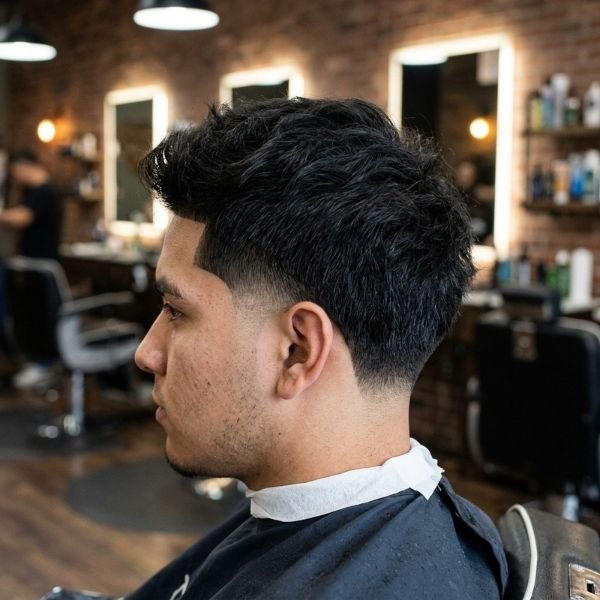
“Mexican” refers specifically to people from Mexico or of Mexican heritage. In barbershops, the Mexican low taper fade usually means a slightly bolder take on the same cut.
It often comes with a crisp line-up (a sharp, defined hairline made with a trimmer), a forward fringe similar to a Caesar cut (a short, horizontal bang named after Julius Caesar), or a thick, shaped top.
These are style trends, not rules. Any man can ask for any version.
Key Features
Look for these traits in a Mexican low taper fade:
- A sharp, detailed line-up at the forehead and temples
- A defined taper with slightly more contrast at the bottom
- A textured fringe, comb-over, or short crop on top
- Clean sideburns, often squared or lightly faded
- A structured shape that looks styled
Best For
This version works well in these cases:
- Men with thick, dark, dense hair
- Guys who like a polished, high-contrast finish
- Those who visit the barber every two to three weeks
- Men who want a bold look that is still not a skin fade
- Anyone who likes a defined hairline
Hispanic vs Mexican Low Taper Fade

| Feature | Hispanic Low Taper Fade | Mexican Low Taper Fade |
| Fade softness | Soft, natural blend | Slightly tighter, more contrast |
| Top style | Curls, waves, or flexible length | Fringe, crop, or structured top |
| Line-up | Light or optional | Sharp and detailed |
| Look | Relaxed and versatile | Polished and bold |
| Touch-up timing | Every 3 to 4 weeks | Every 2 to 3 weeks |
Popular Hispanic & Mexican Low Taper Fade Styles
These are seven of the most requested styles. Each pairs the low taper with a different top:
- Low Taper with Curly Top: Natural curls stay full on top while the sides stay clean. Use a curl cream for definition.
- Low Taper with Textured Fringe: A short, choppy fringe falls forward over the forehead. It is easy to style and looks modern.
- Low Taper Caesar: A short, even fringe sits on top. It suits straight or thick hair and needs almost no styling.
- Low Taper with Slick Back: The top is combed back with pomade (a water-based or oil-based styling product that adds hold and shine). It is a good choice for formal settings.
- Low Taper with Side Part: A clean part is cut or combed in. It works well for office and event looks.
- Low Taper with Waves: A brush-and-wave routine defines the top. Many men with dense, coily hair choose it.
- Low Blowout Taper: The top is blow-dried up and back for height, with a clean low taper below. More on this later in the guide.
Face Shape & Hair Type Guide

The right top style depends on your face shape and hair texture. The low taper stays the same, so you mainly adjust the length and shape above it.
Read more: The Best Complete Guide to Taper Fade Haircut
Face Shapes
Use this list to match your top style to your face:
- Oval: Almost anything works. Try a fringe or a slick back.
- Round: Add height on top and keep the sides tight. A textured quiff helps lengthen the face.
- Square: Soft textures and slightly longer tops balance a strong jaw.
- Oblong: Avoid too much height. A fringe or side part adds width.
- Heart-shaped: A fringe covers a wide forehead, and a fuller top balances a narrow chin.
Hair Types
| Hair Type | Best Top Style | Key Tip |
| Straight | Caesar, side part, slick back | Add texture spray to avoid a flat look |
| Wavy | Textured fringe, quiff | Use a light cream to control frizz |
| Curly | Curly top, blowout | Keep length of 2 to 4 inches for curl shape |
| Coily | Waves, short afro | Moisturize daily and ask for a natural taper |
How to Ask Your Barber
Clear words prevent bad haircuts. Many men say “just a fade,” and barbers then guess the height. One barber guide calls skipping the word “low” one of the most common mistakes: recommends always stating the height and where the fade should begin.
Try this script: “I’d like a low taper fade, blending down to a #1 or #2 at the bottom. Keep it low around the ears and neckline. Leave about 3 inches on top.”
Choose:
Decide these points before you sit down:
- Fade height: Low, not mid or high
- Bottom guard: #1, #2, or a bald (skin) edge
- Top length: Short, medium, or long
- Line-up: Soft, natural, or sharp
- Neckline: Tapered (natural) or squared (blocky)
- Reference photo: Bring one from the front, side, and back
A photo helps most. Words like “short” mean different things to different people, but a picture does not.
Styling & Care Tips
A low taper fade needs little daily work. These habits keep it looking fresh:
- Wash 2 to 3 times a week. Washing every day dries out the scalp, especially with curly or coily hair.
- Use a light conditioner. It softens hair and reduces frizz.
- Pick product by hair type. Use matte clay for a textured look, pomade for a slick finish, and curl cream for curls.
- Apply product to damp hair. It spreads more evenly and gives better hold.
- Moisturize the scalp. A dry scalp can flake, and flakes show up clearly on short sides.
- Sleep on satin or silk. It reduces friction, which helps curls and waves.
For waves, a soft boar-bristle brush used daily trains the pattern over time.
Read more: Low Taper vs Burst Fade: Which Haircut Looks Better on You?
Cost & Touch-Ups
| Barber Type | Typical Price |
| Local barbershop | $15 to $30 |
| City barbershop | $30 to $60 |
| Premium salon | $70 and up |
Do & Don’t Tips
Follow these Do tips for the best results:
- Do bring reference photos
- Do say “low” and name the guard number
- Do book regular appointments
- Do tell your barber about your hair texture
- Do ask about styling products
Avoid these Don’t mistakes:
- Don’t say “just a fade” or “whatever looks good”
- Don’t wash your hair every day
- Don’t skip moisturizer if your hair is curly or coily
- Don’t trim the neckline yourself with kitchen scissors
- Don’t wait until the fade is fully grown out
Final Summary:
The Hispanic and Mexican low taper fade styles share one core: a gentle gradient at the ears and neckline with length kept on top. The Hispanic version leans soft and natural, while the Mexican version leans sharp and defined.
Pick your top style based on your face shape and hair texture, tell your barber the fade height and guard number, and plan a trim every two to three weeks. Do that, and you get a clean cut that works almost anywhere.
Frequently Asked Questions
Are Hispanic and Mexican low taper fades the same?
They share the same base cut. The Mexican version usually adds a sharper line-up or a structured top.
Which is better for office jobs?
The Hispanic low taper fade, since its softer blend and natural top look more conservative.
Which looks bolder?
The Mexican low taper fade, because its crisp edges and defined fringe create more contrast.
Are both good for curly hair?
Yes. Keep 2 to 4 inches on top and ask for a natural taper that follows your curl pattern.