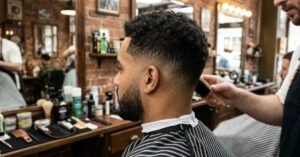
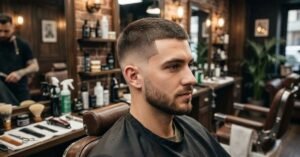
A low taper fade for straight hair is one of the easiest cuts to wear for boys. The sides stay neat, the top keeps its length, and the whole thing grows out without a harsh line. It looks tidy for school, works for sports and takes only a couple of minutes to style.
This guide covers what the cut is, why straight hair suits it, the best styles to ask for, how to talk to your barber, and the mistakes that cause the most regret. Parents can use it to brief the barber, and older boys can use it to ask for exactly what they want.
What a low taper fade is

A low taper fade shortens the hair gradually around the sideburns, the area above and behind the ears and the neckline. It starts low, just above the ears, and leaves the rest of the sides at a longer length. It usually stops above bare skin, so it looks soft.
In plain terms:
- Starts: near the sideburns and nape.
- Sides: blended from short at the bottom to longer above.
- Top: left long enough to style.
- Look: neat, subtle and easy to wear.
It is the gentlest of the taper heights. A mid taper starts higher, and a high taper starts near the temples. Barbers describe these heights differently, so say where you want the blend to begin.
Why it suits straight hair so well

A low taper fade on straight hair holds a shape and shows a clean line, which makes the cut look sharp with very little effort. A few reasons it works:
- The blend shows clearly. Smooth gradients look tidy on straight hair.
- The top holds its shape. A fringe, part or crop stays in place without much product.
- It grows out gently. A low taper keeps some hair at the edges, so it softens over time instead of looking suddenly overgrown.
- It keeps the sides under control. Straight hair can stick out over the ears, and the short edges stop that.
A low taper is also a good starting point for first timers, because it leaves more hair on top and reads as easygoing and polished.
The best styles in 2026
I could not find hard numbers that prove which styles are most requested this year, so here are the looks that barber guides keep featuring on a low taper. Each one works for school and for weekends.
- Textured crop. A short, choppy top, about 1 to 2 inches.
- Textured fringe. A forward top that falls to the brows.
- Middle part. A relaxed split down the centre.
- Side part. A neat, classic part.
- Short quiff. A little lift at the front.
- French crop. A short, straight cut fringe.
Start with the top you like most, then add the low taper fade straight hair base.
Low taper fade with a textured top

A textured top is the easiest low taper fade straight hair option for school. Keep about 2 to 3 inches, and ask the barber to cut it with scissors and point cutting so it breaks into pieces. Straight hair has no natural movement, so the cutting adds it.
To style it:
- Start with damp hair.
- Add a little sea salt spray for grip.
- Rough dry with your fingers.
- Rub a small amount of matte clay between your palms and pinch the top into pieces.
Use very little product. It should look lived in, not styled.
Low taper fade with a fringe

In a low taper fade for straight hair, a fringe falls forward over the forehead, usually to the middle of the forehead or just above the brows. On straight hair, it looks neat if it is textured rather than cut in one solid line.
Tips:
- Ask for point cutting so the fringe breaks into small pieces.
- Keep it above the eyebrows for school and sports.
- Trim it more often than the rest of the cut. Fringes grow fast, and some guides suggest every three weeks to keep it above the brows.
Low taper fade with a middle part

A middle part on a low taper fade for straight hair gives a relaxed, slightly retro look. Straight hair parts easily, so this is one of the simplest styles to achieve.
Keep these points in mind:
- You need enough length to fall on both sides, usually 3 to 4 inches.
- A cowlick at the front can fight the part, so tell your barber where it is.
- Comb it into place while the hair is damp, then let it dry.
- A light cream keeps the sides from flipping.
If the hair will not stay split, a side part may suit your growth pattern better.
Low taper vs mid taper

| Low taper | Mid taper | |
|---|---|---|
| Starts | Just above the ears | Around the middle of the sides |
| Contrast | Subtle | Medium |
| Look | Soft and neat | Sharper and more defined |
| Upkeep | Lower | Medium |
A low taper holds its shape for about a month and is easy to grow out. A mid taper looks sharper but needs trims more often, sometimes every two to three weeks. For boys, the low taper is usually the safer choice because it is gentler and fits most school rules.
Which face shapes suit it
A low taper works on nearly every face shape, so you have a lot of room. A few general notes:
- Oval: wears any version.
- Round: can use extra length on top to add height.
- Square: a softer top balances a strong jaw.
- Long or oblong: a fringe or a flatter top helps, and a low taper keeps the sides from lengthening the face.
- Heart shaped: a low to mid taper with a fringe works well.
Sources disagree on a few of these, since some say round faces suit a mid or high taper. The simplest approach is to ask your barber, who can see how the hair sits on your head.
How to ask your barber for it
When you book a low taper fade for straight hair, remember that barbers cannot read minds, and a front photo only shows one angle. Bring photos of the front, side and back, and describe the cut in words too.
Cover these points:
- Taper height: “Low taper, starting just above the ears.”
- Bottom length: a guard number, such as a number 2 (about 1/4 inch), or “just above skin.”
- Top length: in inches, such as “about 3 inches.”
- Top style: crop, fringe, middle part or side part.
- Texture: “Point cut for texture.”
- Neckline: tapered, rounded or squared.
A script you can read out:
“I would like a low taper fade on the sides and back, blended down to a number 2 at the neckline. Leave about 3 inches on top, point cut for texture, with a fringe that stops just above the eyebrows. Tapered neckline please.”
If you are unsure, ask the barber to start longer. They can always cut shorter next time.
Styling and upkeep at home
A low taper fade for straight hair needs little daily work.
Daily routine
- Towel dry until damp.
- Add a pea sized amount of matte clay or light cream.
- Style with your fingers, or comb for a part.
- Check that the sides sit flat.
Products
- Sea salt spray: grip and texture.
- Matte clay or paste: definition without shine.
- Light cream: a soft hold for parts and fringes.
Keep products lightweight, since heavy ones flatten the top.
Upkeep
- Book a trim about every 3 to 4 weeks to keep the edges tidy, and up to 6 weeks if you like it softer.
- Fringes may need a trim in between.
- Wash regularly, and condition if the hair gets dry.
- Leave the blend to the barber. Fixing it at home usually leaves patches.
Common mistakes to avoid
Fade too high
A high start turns a low taper into a mid or high one. It looks bolder, shows regrowth sooner and may break school rules. If you are unsure, start low.
Top cut too short
For a low taper fade on straight hair, the top needs some length to style. If the top is too short, the cut looks flat and there is nothing to part or push forward. Keep at least 2 inches for most styles.
Reaching for gel
Strong gel can make straight hair look stiff, clumpy and shiny. Choose matte clay, paste or a light cream instead.
Only describing the fade
The top matters as much as the sides. Say the length, the style and the texture, not just “low taper.”
Skipping school rules
Many schools have rules about hair length, designs, colors or extreme fades. Check the handbook, and tell the barber about any limits before the cut starts. A low taper is usually a safe choice.
Leaving it too long
The blend softens as hair grows. After about four to six weeks, the taper stops looking sharp. Book the next visit before you leave the chair.
Frequently asked questions
What is a low taper fade for boys?
It is a haircut where the hair shortens gradually around the sideburns, ears and neckline, with the top left longer.
Is a low taper fade good for straight hair?
Yes. Straight hair holds a clean blend and a neat top shape with very little effort.
How long should the top be?
About 2 to 4 inches works for most styles, with 2 to 3 inches for a textured crop.
How often should boys get a low taper fade trimmed?
About every 3 to 4 weeks keeps it tidy, and up to 6 weeks works for a softer look.
What is the difference between a low taper and a mid taper?
A low taper starts just above the ears and looks subtle, while a mid taper starts higher and looks sharper.
Is a low taper fade allowed at school?
It usually is, since it is subtle, but check your school’s rules before the cut.
What products work best on straight hair?
Sea salt spray, matte clay or paste, and light cream. Avoid strong gel.
What should I tell the barber?
Say where the taper starts, how short the bottom goes, the top length and style, and the neckline, and bring photos.
Conclusion
A low taper fade for straight hair gives boys a neat, easy cut that fits school, sport and weekends. Pick the top style you like, keep enough length to style it, and describe the whole cut to the barber, not just the fade. Use light products, book regular trims and check school rules, and the cut will look good from the first day to the last.
Want more taper fade guides?
If you are still comparing options, read about the low taper fade vs mid taper fade, the mid taper fade for straight hair and taper fade styles for thick hair. Seeing them side by side makes the choice easier.