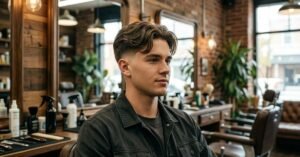
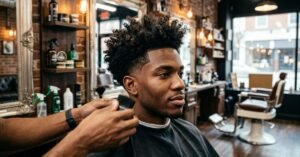
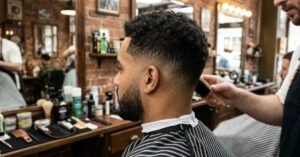
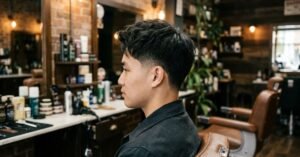
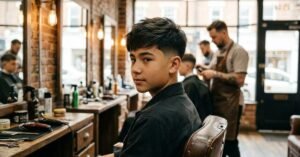
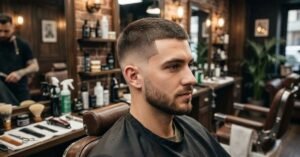
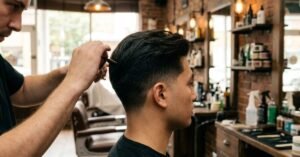
A low taper fade Asian hair cut is one of the easiest ways to keep thick hair under control. The sides stay neat, the top keeps its weight and shape, and the cut grows out without a harsh line. It works for straight, thick, wavy and textured hair, as long as the barber plans for your growth pattern.
This low taper fade Asian hair guide covers what the cut is, why it suits dense hair, the best styles for each hair type, a barber script and a simple upkeep plan. Asian hair varies a lot, so use the tips as a starting point and adjust them to your own head.
What is a low taper fade for Asian hair?

A low taper fade shortens the hair gradually around the sideburns, behind the ears and along the neckline. The blend starts low, just above the ear, and the sides and top stay longer. It is the gentlest taper, so it looks subtle and tidy.
For Asian hair, the cut does two jobs. It removes bulk where thick hair sticks out, and it frames the top without a strong contrast. One barber guide describes Asian men’s hair as thick, straight and strong, which is why a clean, controlled outline matters so much.
Key features:
- Starts low: around the sideburns and nape.
- Blends gradually: short at the bottom, longer above.
- Leaves the top long: enough to part, push forward or texturize.
- Grows out well: the edges soften instead of looking suddenly overgrown.
Low taper vs mid vs high fade

| Cut | Where it starts | Contrast | Look |
|---|---|---|---|
| Low taper fade | Just above the ears and nape | Subtle | Soft, neat |
| Mid taper fade | About level with the top of the ear | Medium | Clean, defined |
| High taper fade | A couple of inches above the ears | High | Bold, sharp |
Why the technique suits Asian hair density and texture
Thick, straight hair has a lot of weight, and a low taper fade Asian hair cut handles it well. On the sides, that weight can push outward and make the head look wider. A low taper removes that weight around the ears and neckline, so the outline looks neat.
A few more reasons it works:
- Straight hair shows a clean blend. Smooth gradients stand out when the strands lie flat.
- Dense hair holds a shape. The top keeps its form without much product.
- The low start protects growth patterns. Strong cowlicks at the crown or nape are easier to manage when the cut is gentle.
- It looks planned as it grows. The blend softens over four to six weeks, with no obvious step.
Hair type varies across Asian communities, so there is no single rule. Tell your barber how your hair behaves, especially at the crown, hairline and nape.
Best low taper fade styles for straight and thick hair
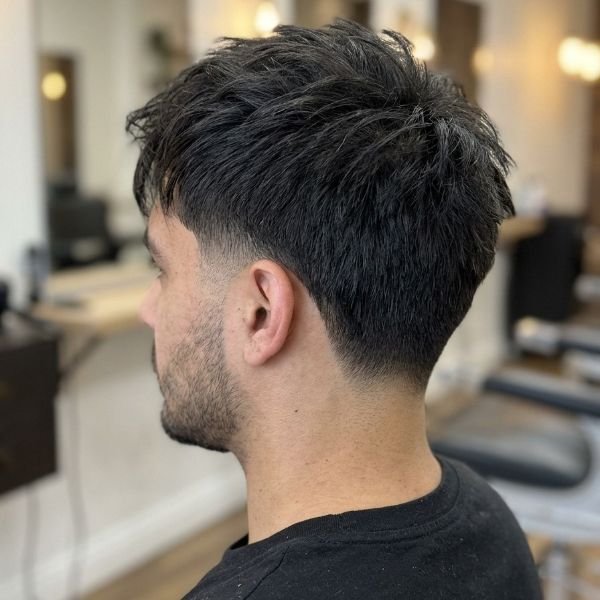
For a low taper fade Asian hair style, straight hair has no natural movement, so the top needs texture from the cutting. Ask for point cutting or choppy layers, and keep enough length to style.
- Textured crop. About 1 to 2 inches on top, cut into choppy pieces. It is the easiest option for thick hair.
- Short textured fringe. A forward top about 2 inches long that falls above the brows. Keep it light so it does not look heavy.
- Two block cut. The sides are cut shorter and disconnected from a longer top. It is popular with Asian men, and a low taper softens the contrast.
- Middle part with taper. A relaxed, slightly retro look. It needs about 3 to 4 inches to fall on both sides.
- Side part. Neat and professional. Comb it into place while damp.
- Slick back with a low taper. Polished and clean. Works best on thick, straight hair with 3 inches or more.
- Comb over. A formal, tidy finish for the office.
- Messy quiff. A lifted front with a loose finish, for men who want height.
Thick hair often needs internal layering or thinning. Ask your barber to remove weight from the top, so it does not sit like a helmet.
How the cut works on wavy and textured Asian hair

Wavy and textured hair gives you free movement, and a low taper fade Asian hair cut keeps it tidy. The goal is to frame the pattern, not fight it.
For wavy hair:
- Keep the top at about 3 inches, so the waves have room to form.
- Ask for light texturizing, not heavy thinning, which can cause frizz.
- Use a light cream or sea salt spray and let it dry naturally.
For curly or textured hair:
- Keep roughly 2 to 3 inches on top, since curls shrink as they dry.
- Ask the barber to cut it dry, so they see how it falls.
- Use curl cream on damp hair and diffuse on low heat.
If your hair is straight and you want more shape, you can ask a barber about a perm on the top. Some guides suggest it for a wavy two block or a spiral perm for a longer curly style. Plan a perm with the stylist who will do it, and keep the low taper as the base.
Choosing a style for your face shape
| Face shape | Good choice | Why |
|---|---|---|
| Oval | Almost any top | Balanced proportions |
| Round | Quiff or textured crop with height | Adds length |
| Square | Textured fringe or side part | Softens the jaw |
| Long | Fringe or flatter top | Avoids adding height |
| Heart | Low taper with a fringe or side part | Balances the chin |
Low taper vs mid taper: which should you pick?

| Low taper | Mid taper | |
|---|---|---|
| Look | Soft and subtle | Sharper and more defined |
| Best for | Work, school, first timers | Men who want clear contrast |
| Upkeep | Lower | Medium |
| Grow out | Very easy | Easy |
How to ask your barber for a low taper fade
When you book a low taper fade Asian hair cut, remember that barbers cannot read minds, and a front photo only shows one angle. Bring photos of the front, side and back, and describe the cut in words too.
Cover these points:
- Taper height: “Low taper, starting just above the ears.”
- Bottom length: a guard number, such as a number 2 (about 1/4 inch), or “just above skin.”
- Top length: in inches, such as “about 3 inches.”
- Texture: “Point cut it and remove weight.”
- Top style: fringe, crop, part or quiff.
- Neckline: tapered, rounded or squared.
- Hair notes: “I have a cowlick at the crown,” or “my hair grows outward at the sides.”
A script you can read out:
“I would like a low taper fade, tight around the sideburns and nape, blended down to a number 2. Leave about 3 inches on top, point cut with some weight removed, and a light fringe. Keep the neckline tapered.”
Ask the barber to start longer. They can cut shorter next time.
How to style the top: fringe, quiff, or textured crop

Style on damp or nearly dry hair, and use a pea sized amount of product. Thick hair can handle more hold, but too much looks heavy.
Fringe
A fringe falls forward to the brows or mid forehead.
- Towel dry the hair until damp.
- Add sea salt spray for grip.
- Blow dry with your fingers, pushing the hair forward.
- Warm a little matte clay between your palms.
- Pinch the front into small pieces.
Ask for point cutting, so the fringe breaks up instead of sitting in one solid line.
Quiff
A quiff lifts the front for height.
- Apply mousse or texture powder to damp hair.
- Blow dry the front upward with a round brush.
- Add a medium hold paste or wax.
- Shape the lift with your fingers and set it with a light spray if needed.
Thick, straight hair holds a quiff well, but it needs a blow dry to keep its shape.
Textured crop
A textured crop is short and choppy, about 1 to 2 inches.
- Rough dry the hair.
- Rub a little matte paste or clay between your fingers.
- Push the top forward and pinch for separation.
It takes about two minutes, and it is the best choice for low effort.
Product guide
| Product | Best for | Finish |
|---|---|---|
| Matte clay or paste | Fringes, crops, quiffs | Natural, no shine |
| Sea salt spray | Prep for lift | Light grip |
| Texture powder | Volume at the roots | Matte lift |
| Pomade | Slick backs and side parts | Neat, with or without shine |
| Light cream | Soft fringes and waves | Gentle hold |
How often to maintain a low taper fade
A low taper fade Asian hair cut lasts longer than most fades, since the blend sits close to the natural hairline. Hair grows about half an inch a month, so you will see regrowth in a few weeks.
- Taper and neckline: about every 3 to 4 weeks, or up to 6 weeks for a softer look.
- Fringe: about every 3 to 4 weeks to keep it above the brows.
- Textured top: every 4 to 6 weeks.
- Skin finish at the bottom: sooner, about every 2 to 3 weeks.
These ranges are general. Thick, fast growing hair may need visits sooner.
Between visits:
- Tidy only the neckline at home, and leave the blend to your barber.
- Wash regularly, and condition if your hair feels dry.
- Keep products light, and wash them out at night.
- Book the next appointment before you leave the chair.
Final takeaways
A low taper fade Asian hair cut gives thick hair a clean outline and an easy daily routine. Choose a top that fits your hair type, ask for texture and weight removal, and describe the taper, bottom length and top separately. Keep products light, plan regular trims and start longer if you are unsure.
Frequently asked questions
Is a low taper fade good for Asian hair?
Yes. It removes bulk at the sides and keeps the top shape, which suits thick, straight hair.
What is the best top style for thick straight hair?
A textured crop, short fringe or two block cut works well, with point cutting to remove weight.
How long should the top be?
About 2 to 4 inches works for most styles, and 1 to 2 inches for a short crop.
Does a low taper fade work on wavy or textured Asian hair?
Yes. Keep about 2 to 3 inches on top and cut the hair dry so the pattern shows.
What is the difference between a low taper and a mid taper?
A low taper is softer and starts just above the ears, while a mid taper starts higher and looks sharper.
How often should I get a low taper fade trimmed?
About every 3 to 4 weeks, or up to 6 weeks for a softer look.
What should I tell my barber?
Say where the taper starts, how short the bottom goes, the top length and style, and mention any cowlicks.
Want more taper fade guides?
If you are still comparing options, read about the low taper fade vs mid taper fade, the mid taper fade for straight hair, the high taper fade and the textured fringe haircut. Seeing them side by side makes the choice easier.