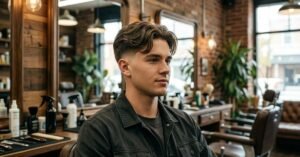
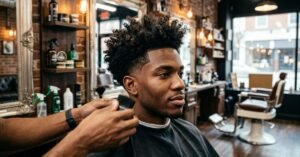
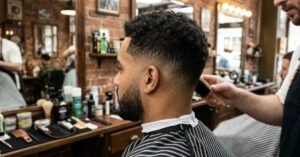
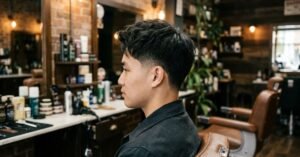
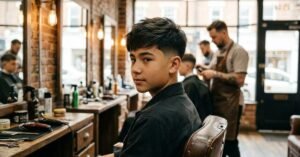
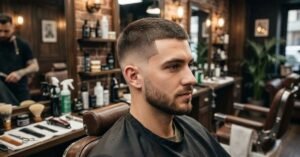
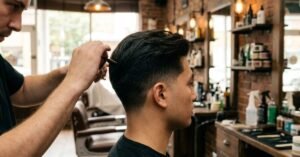
A low taper drop fade is a soft, low starting fade that curves down behind the ear toward the nape. It keeps the sideburns and neckline tidy, adds a gentle arc to the sides and leaves the top free for almost any style.
The name is also confusing, because barbers and websites use “taper,” “fade” and “drop” loosely. This guide explains the cut in plain terms, shows which styles pair with it and gives you a checklist, a script and a care plan.
What is a low taper drop fade?
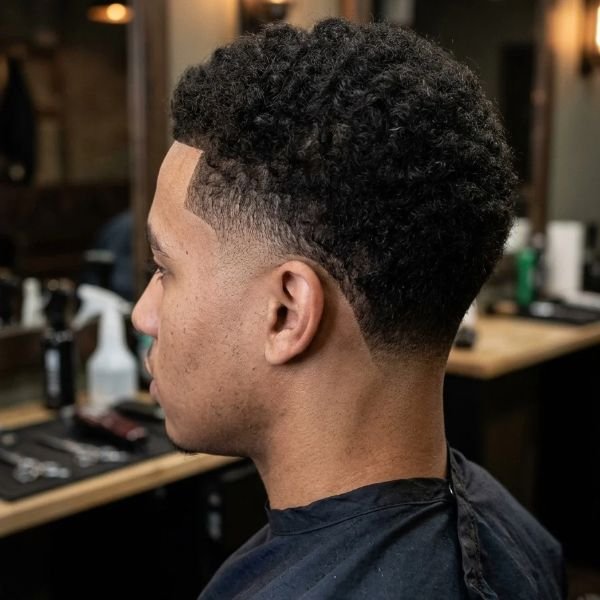
It combines three ideas:
- Low: the blend starts low, close to the sideburns, the ear and the nape.
- Taper: the hair shortens gradually, so the change from long to short is smooth, not abrupt.
- Drop: the line dips behind the ear and follows the curve of the head toward the neck, instead of running level around it.
A taper is a gradual change in length. A fade is when that change reaches very short hair or skin. In a low version, the short part is small, often just the last bit at the bottom. That is why the cut looks subtle from the front and cleaner from the side and back.
Is it the same as a low drop fade?
Close, but not always. A low drop fade usually goes shorter, often to skin, and the dip behind the ear is more visible. A low taper drop fade keeps a little more hair and a softer finish. Sources and barbers differ, so treat this as a working guide and confirm with a photo and a guard number.
Low taper drop fade vs similar cuts

| Cut | Where it starts | Path | Look |
|---|---|---|---|
| Low taper fade | Just above the ears | Fairly level around the head | Soft, neat |
| Low taper drop fade | Just above the ears | Dips behind the ear | Soft with a curve |
| Low drop fade | Low, often to skin | Dips behind the ear | Sharper |
| Mid drop fade | Mid side | Dips behind the ear | Bold |
| Burst fade | Around the ear | Half circle, neck stays long | Rounded |
In short:
- A low taper fade stays level. A drop version dips behind the ear.
- A burst fade curves around the ear and leaves length at the neck. A drop fade carries the line lower toward the nape.
- A disconnected drop fade separates the faded sides from a longer, textured top with no blend between them.
Anatomy of the cut: fade path, blend, and finish
Fade path and weight distribution
The fade path is the line the blend follows. In a low taper drop fade:
- It starts near the temple or sideburn.
- It runs back above the ear.
- It dips behind the ear and continues toward the nape.
This path moves weight. The sides and back carry less hair, and the top and crown keep the volume. A good blend has no visible steps, and the top rolls over it without a shelf.
Skin, shadow, and natural finishes
The finish is how short the bottom goes. Pick it separately from the shape.
- Skin: bare skin at the lowest point. Sharpest, and shows regrowth fastest.
- Shadow: very short, not bare. Softer and more forgiving.
- Natural taper: the edge stays above skin and blends into the top. The gentlest and the easiest to grow out.
Clipper guards help you name it. A zero is the closest, a number 1 is about 1/8 inch and a number 2 is about 1/4 inch.
Who it suits: hair type, density, and head shape
The cut works on most heads, but a few details matter.
Hair texture and density
- Straight hair: shows a clean blend, so ask for careful work.
- Wavy hair: keeps its movement, and the taper stops the sides puffing out.
- Curly and coily hair: frames the top well. Cut it dry and leave extra length for shrinkage.
- Thick or dense hair: benefits from the removed bulk and shows sharp definition.
- Fine or thin hair: a shadow or natural finish looks fuller than skin.
Head shape, hairline, and face shape
- Flat spots or bumps: a drop curve follows the head, so feel for them before you choose a very short finish.
- Receding hairline: a low start is gentler than a high one.
- Round face: height on top balances short sides.
- Long face: a fringe or flatter top keeps the face from looking longer.
- Square or oval face: wears most versions.
Face shape matters less than density and growth pattern. Tell your barber about cowlicks at the nape.
Best low taper drop fade styles
Choose the top first, then the taper.
Short, clean styles
Textured crop
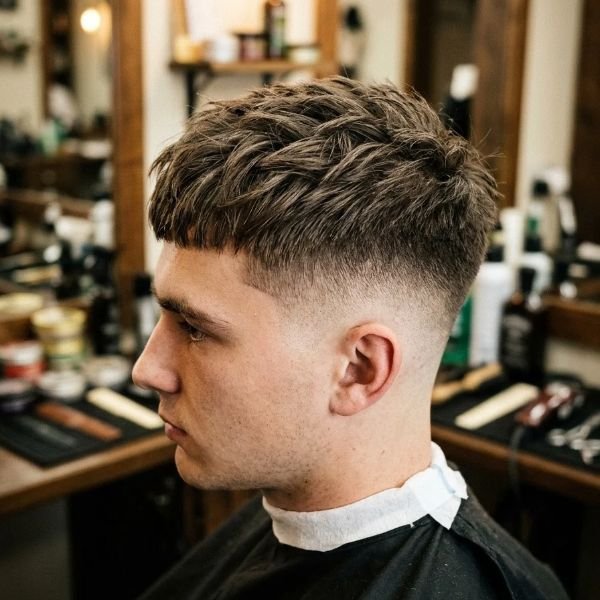
A short, choppy top of about 1 to 2 inches, with point cutting. The easiest option.
Crew cut or buzz cut
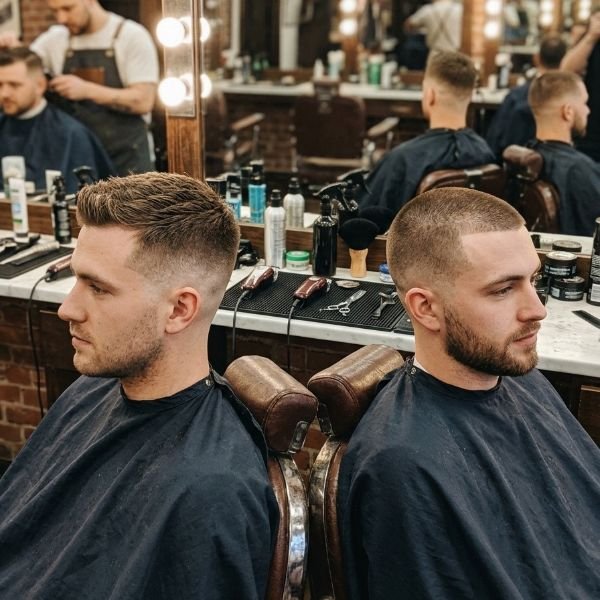
An even short top with a soft drop at the sides. Needs the most frequent visits to look crisp.
Caesar or French crop
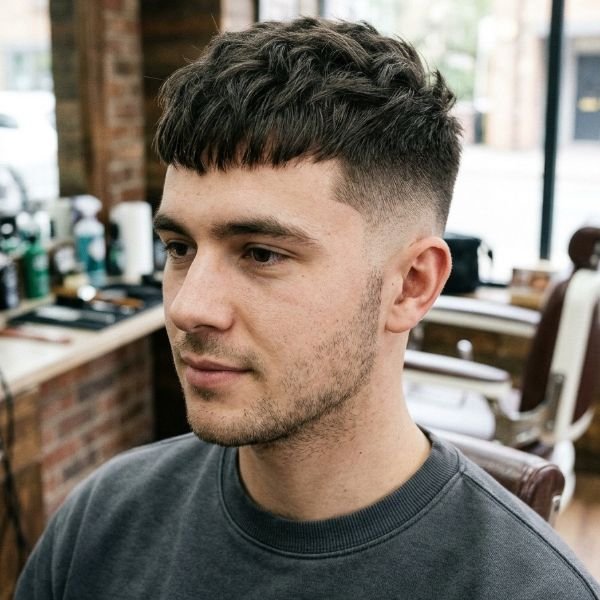
A short, straight fringe over a short top. It looks structured and works well on straight hair.
Volume and movement on top
Textured fringe or blowout

A fringe at the brows, or a thick blowout of about 3 to 4 inches. The drop gives the heavy top a clean base.
Quiff or side part
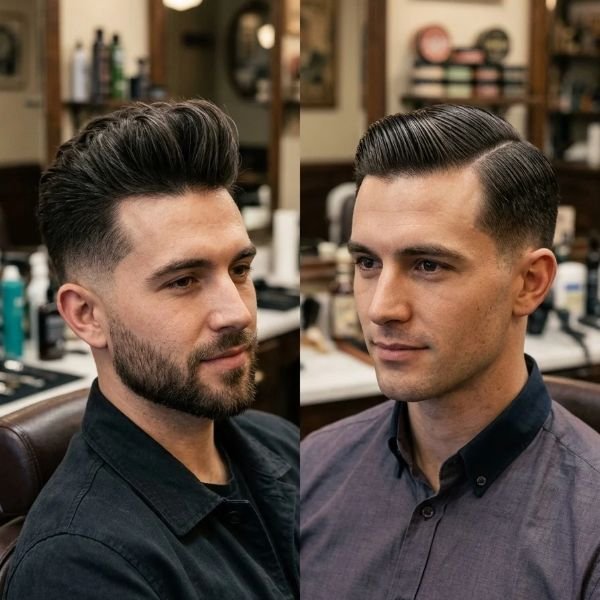
A lifted quiff adds height, and a side part looks formal. Both look sharp against the low taper.
Slick back
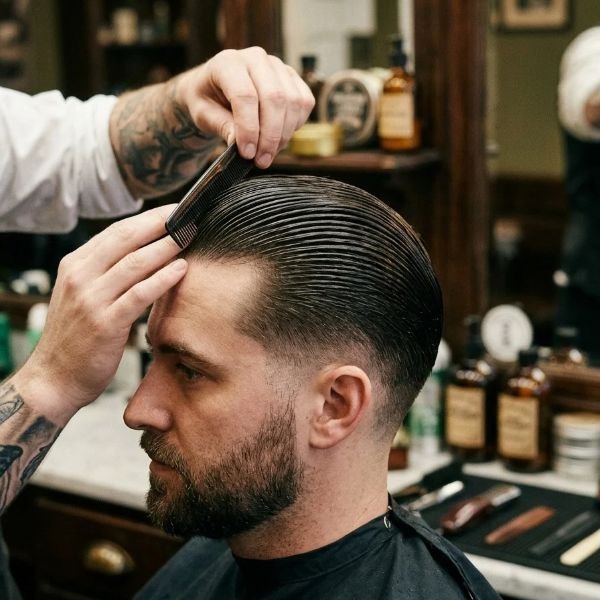
A polished, combed back top with about 3 inches or more. Use pomade, and keep product off the sides.
Curly, coily, and wave styles
Curly top
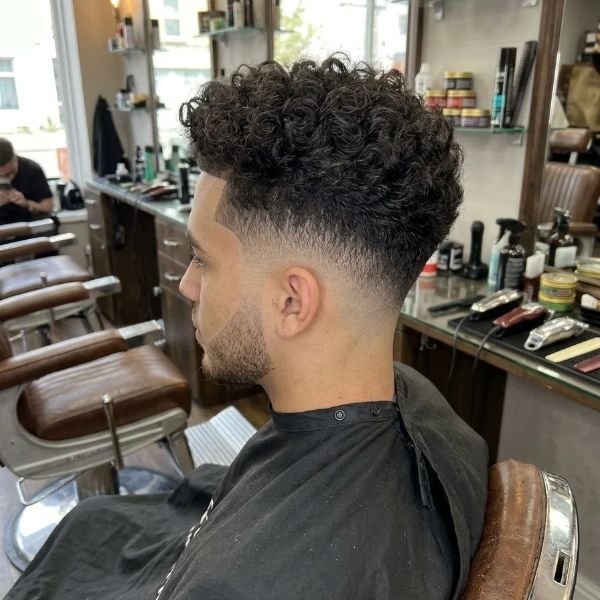
Curls of about 2 to 3 inches on top. The drop frames the shape cleanly.
Short afro or defined coils
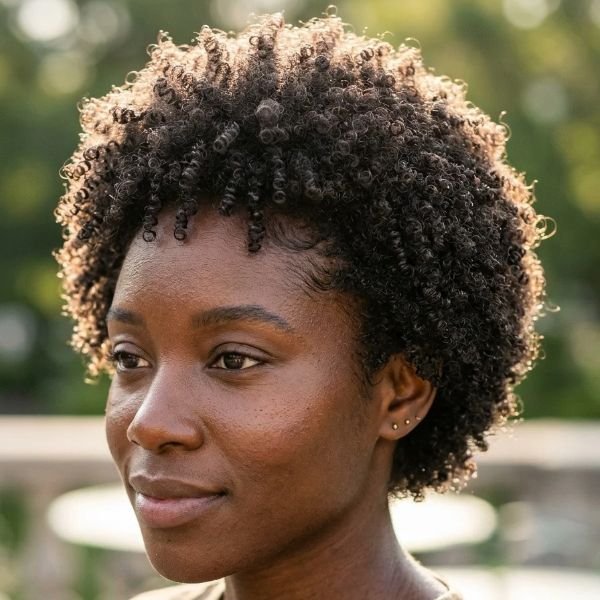
A rounded top with a clean outline. Leave a little extra length for shrinkage.
360 waves
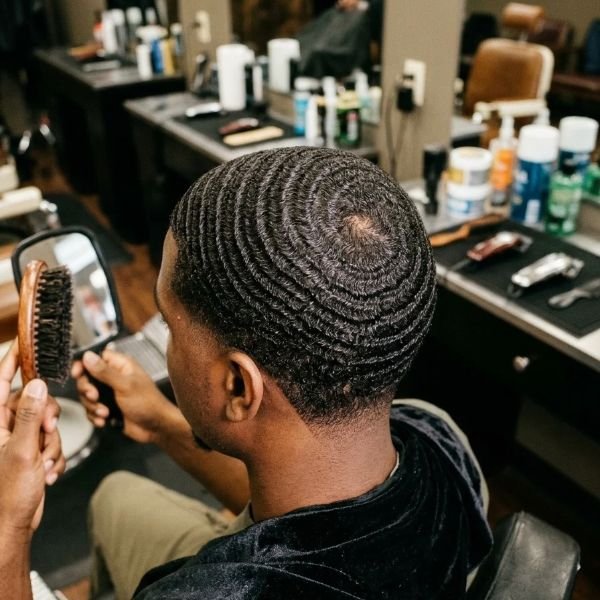
The low taper drop fade gives waves a tidy edge. Brush and wave care matter, and the cut should follow the wave pattern.
Statement variants
Hard part or shaved design

A shaved line or design cut into the side. Check that your barber is comfortable with detail work.
Mullet or faux hawk

A longer back or a raised center strip. The drop path suits both, since it follows the curve of the head.
How to ask your barber for a low taper drop fade
Barbers cannot read minds, and a front photo shows only one angle. Bring photos from the front, side and back.
Five details to specify
- Height: “Low, starting just above the ear.”
- Path: “Dropping behind the ear, toward the nape.”
- Bottom finish: skin, shadow or a guard number.
- Top length and style: inches, plus crop, fringe, quiff or curls.
- Neckline and hairline: tapered, rounded or squared, and natural or lined up.
A sample script
“I would like a low taper drop fade. Start the blend just above the ear and let it drop behind the ear toward the nape, down to a shadow at the bottom. Leave about 3 inches on top, point cut for texture. Tapered neckline and a natural hairline please.”
If you are unsure, ask the barber to start longer. They can cut shorter next time.
Check where your reference photo came from
Not every photo is a reliable guide. Before you show one, check:
- Hair match: is the hair similar to yours in texture and density?
- Angles: does it show the side and back, where the drop appears?
- Editing: heavy filters, lighting or AI generated images can show blends that are not realistic.
- The name: the caption may say “drop fade” for a different cut.
If the photo is unclear, describe the cut in words, and ask the barber what they see.
Styling, maintenance, and grow-out
Styling by hair type
- Straight: sea salt spray, then matte clay or paste.
- Wavy: light cream on damp hair, and let it dry naturally.
- Curly and coily: curl cream, scrunch and diffuse.
- Slick or sleek: pomade or gel, applied to the top only.
Keep product off the sides, since heavy product hides the blend.
Touch-up timing and grow-out signals
A low taper fade looks best for about two to four weeks, and one guide says it can grow out well for up to eight weeks. A skin finish needs touch ups sooner, about every two to three weeks. Hair grows about half an inch a month.
Signs it is time for a trim:
- The blend looks fuzzy behind the ear.
- The neckline has lost its line.
- Sideburns look uneven.
- The top has lost its shape.
To grow it out, keep the top longer and ask the barber to raise the finish at each visit. Over a few months it softens into a regular taper.
Common mistakes, risks, and edge cases
Result problems and their fixes
| Problem | Likely cause | Fix |
|---|---|---|
| Visible lines in the blend | Guards not blended | Go back for a quick blend |
| Fade starts too high | Misread height | Ask for a lower start next time |
| Drop looks uneven | Sides not matched | Ask the barber to check both sides in a mirror |
| Top looks flat | Too short or not textured | Keep 2 inches or more, and ask for point cutting |
| Patchy back | Home trimming | Leave the blend to the barber |
Scalp, hairline, and skin edge cases
- Razor bumps: very short cuts at the nape can lead to bumps. See a dermatologist if they are painful, spread or keep returning.
- Scalp exposure: thin hair and fair skin show more scalp. Use a shadow finish, and wear sunscreen.
- Receding hairline: a lined up front can make it look further back. Keep the hairline natural.
- Sensitive skin: tell the barber, and ask how they clean their tools.
- Cowlicks: can disrupt the blend, so point them out.
This guide is general grooming advice, not medical advice.
Alternatives to a low taper drop fade
- Low taper fade: a level version with less curve.
- Burst fade: a rounded arc that leaves length at the neck.
- Mid taper fade: more contrast and definition.
- Scissor cut with tapered sideburns: the most conservative.
- Undercut: short sides in one length, with no gradual blend.
If you are unsure, a low taper is the safest start.
Frequently asked questions
What is a low taper drop fade?
It is a low starting taper that dips behind the ear and follows the curve of the head toward the nape.
Is a low taper drop fade the same as a low drop fade?
Not always. A low drop fade usually goes shorter, often to skin, while a low taper drop fade keeps a softer finish.
How often should I get it trimmed?
Every 2 to 4 weeks for the sharpest look, and sooner for a skin finish.
Does a low taper drop fade work on curly hair?
Yes. Keep about 2 to 3 inches on top, and ask for a dry cut.
Is it good for work or school?
Yes. The low start is subtle, though a skin finish may be bolder than some rules allow.
What should I tell my barber?
Say the height, the drop path, the bottom finish, the top length and the neckline, and bring photos.
The bottom line
A low taper drop fade gives you a soft, curved fade that suits most hair types and styles. Pick the top you want, choose the finish separately, and describe the height, path, bottom, top and neckline to your barber. Bring clear photos, keep products light and book regular trims.
Want more taper fade guides?
If you are still comparing options, read about the low taper fade vs mid taper fade, the burst fade vs drop fade, the low taper fade for straight hair and the high taper fade. Seeing them side by side makes the choice easier.