
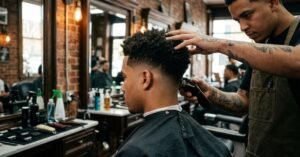
Curly hair has a mind of its own. It adds volume, shrinks when it dries, and can look bulky on the sides if you let it grow. A fade for curly hair solves that problem by keeping your curls full on top while the sides and neckline stay clean.
The best fades for curly hair are the low fade and the low taper fade. Both start near the ears and neckline, so they protect your curl volume and look natural as they grow out.
This guide explains the difference, shows the best styles, and gives you the exact words to use in the barber chair.
Quick answer: If you want a soft, natural look, ask for a low taper fade. If you want sharper contrast and a bold edge, ask for a low fade. For 3C and coily hair, a low taper with a soft blend is the safest first choice.
Why a Fade Works Well for Curly Hair
Curly hair grows out and up, not down. Without regular shaping, the sides puff out and the head looks wider than it is. A fade removes that extra width and leaves your curl pattern untouched where it matters most.
Here is why a fade suits curls so well:
- It controls bulk. Shorter sides stop the “triangle” shape that thick curls can form.
- It shows off texture. Clean sides make curls on top look more defined by contrast.
- It saves time. You style only the top, which means a shorter morning routine.
- It works at every length. You can keep a short crop or grow a long curly top.
- It suits many settings. A low fade looks fine at school, at the office, and on weekends.
One thing matters more with curls than with straight hair: fade height. A high fade climbs into the curly area and removes volume. Keeping the fade low protects the shape of your hair. This is why barbers often point curly clients toward low options first.
What Is a Low Fade for Curly Hair?

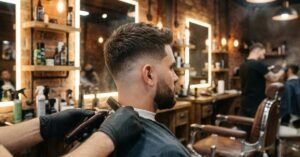
A low fade is a cut where the hair blends from short to very short, starting low on the head. The fade begins just above the ears and follows the hairline around the back of the neck. Most low fades blend down to the skin or very close to it.
On curly hair, this gives you:
- Clean sides and a tidy neckline
- A visible contrast between the faded area and your curls
- Full curl length and volume on top
A low fade is a good pick if you like a sharper, more modern finish. It also shows off a line-up (a crisp edge at the hairline) very well.
What Is a Low Taper Fade for Curly Hair?

A low taper fade is softer than a regular fade. The hair gets gradually shorter around the sideburns, ears, and neckline, but the sides stay a little longer overall. It usually does not go all the way to bare skin unless you ask for that.
The taper happens in two main areas:
- Around the ears and sideburns
- At the neckline
Because the change in length is gentle, the low taper fade looks natural on curly hair. There is no hard line where curls meet the faded section, so the cut looks clean even when it is a few weeks old.
Read more: Fade Haircuts
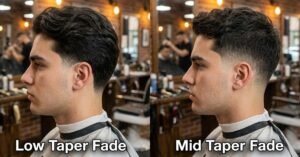
Low Fade vs Low Taper – Simple Difference
| Feature | Low Fade | Low Taper Fade |
|---|---|---|
| Starting point | Just above the ears | Just above the ears and sideburns |
| Hair removed | More | Less |
| Contrast | Strong and bold | Soft and natural |
| Skin showing | Often yes | Usually no, unless requested |
| Grow-out | Visible line after 2 to 3 weeks | Blends evenly for longer |
| Best for | Trendy, sharp looks | School, office, first-time fades |
Best Low Fade Styles for Curly Hair
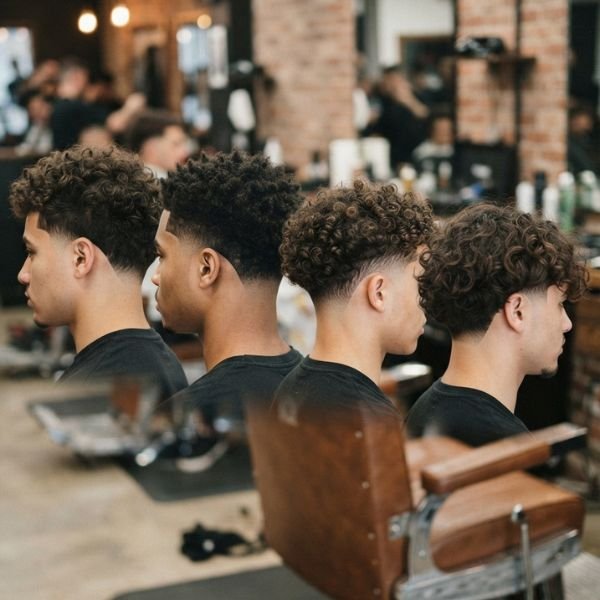
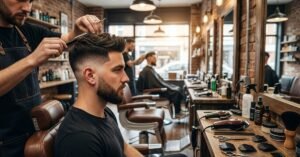
A low fade gives you a clean frame, so the top can do the talking. These styles work well with curls.
1. Low fade with curls on top The classic. Keep three to four inches of natural curl on top and let the fade handle the sides. It works on 3A to 3C hair.
2. Low skin fade The sides blend all the way to the skin. This is a strong option for thick curly hair because it removes bulk fast. A skilled barber is important here.
3. Low fade with a curly fringe Longer curls fall forward over the forehead. The low fade keeps the sides sharp so the fringe looks planned, not messy.
4. Low fade with a line-up A crisp edge along the hairline makes the whole cut look fresh. It suits tighter curls and coily textures well.
5. Low drop fade The fade curves down behind the ear and follows the shape of your head. It is a flattering choice for any curl type.
6. Low fade with a hard part A razor-cut part adds a sharp detail. It pairs well with curly hair that has enough length to fall naturally on both sides.
Best Low Taper Fade Styles for Curly Hair

A low taper fade is the safest, most forgiving choice for curly hair. These are the styles worth saving for your next visit.
1. Low taper fade with curls on top The everyday default. Natural curls on top, a soft taper at the sides. It needs little product and looks good air-dried.
2. Low taper with short curly hair Ideal for students or anyone who wants an easy routine. Keep the top about two to three inches and use a light curl cream.
3. Low taper with a textured fringe A short curly fringe with a gentle taper looks modern without trying too hard. It works especially well on 2C to 3B curls.
4. Low taper with long wavy or curly hair If you like length, a low taper keeps the sides neat without cutting into the shape. It is a good fit for longer curls and a man bun.
5. Blowout low taper fade The curls are dried up and out for extra height. This look is popular for 3B to 4A hair and gives a bold shape with a clean base.
6. Low taper with a burst The fade curves around the ear for more movement. It is an advanced request, so bring a clear photo.
Low Taper for 3C / Coily Hair:
3C and coily hair needs a little more care at the barber. Tight curls shrink a lot, show every uneven line, and are more likely to get razor bumps if the cut is too close.
A low taper works well because it:
- Keeps the tight curl pattern full and rounded
- Avoids a harsh line between coils and faded sides
- Maintains curl shape as the hair grows
- Lowers the risk of irritation from very close cuts
Good options for 3C and coily hair include the afro low taper, the curly top with a line-up, and the blowout low taper. If you want skin at the neckline only, you can ask for a fade just at the nape and a soft taper on the sides. Choose a barber who has experience with Type 3C and Type 4 hair, because blending tight coils takes skill.
Read more: Low Taper vs Burst Fade: Which Haircut Looks Better on You?
Choosing the Best Fade by Hair Type
| Hair Type | Best Choice | Why |
|---|---|---|
| Thick curly hair | Low fade or low skin fade | Removes bulk and reduces side width |
| Thin or loose curls | Low taper fade | Avoids exposing the scalp |
| Long or wavy hair | Low taper | Keeps length and natural shape |
| 3C or coily hair | Low taper with soft blend | Protects curl pattern and skin |
| Wavy 2A to 2C hair | Low taper | Keeps sides in proportion |
A quick note on face shape:
- Round face: Add height on top and keep the fade low and tight.
- Square face: Soft curls on top balance a strong jaw.
- Long face: Avoid very tall tops and keep the sides a little fuller.
- Heart-shaped face: A low taper with slightly fuller sides balances a narrow chin.
Best Fade for Daily Life
Your routine matters as much as your curls. Use this list to match the cut to your day.
- Students: low taper with short curly hair
- Office workers: low taper fade with curls on top
- Low maintenance: low taper fade
- Trendy look: low fade with a line-up or low skin fade
- Active lifestyle: low taper, since it grows out neatly between visits
How to Tell Your Barber:
Most bad haircuts come from unclear words. Barbers use “low,” “mid,” and “taper” differently, so be specific.
Try this simple script:
“I want a low taper fade. Start just above my ears, keep it soft around the neckline, and leave about three inches of curl on top. Please cut the top dry.”
Here is a short checklist to cover:
- Fade height: say “low,” not “short” or “medium”
- Bottom finish: skin, a #0.5 or #1 guard, or leave some stubble
- Top length: give a number of inches or say “finger length”
- Neckline: natural (grows out better) or blocked (looks sharper at first)
- Dry cutting: ask for the top to be cut dry so the curls are judged at true length
Curly hair shrinks as it dries. A style that looks long when wet can end up much shorter once it springs back. Always ask your barber to plan for shrinkage.
Avoid:
- Saying “just a fade” or “a medium fade,” since it means different things to different barbers
- Letting the barber cut the top while it is soaking wet
- Asking for a high fade if you want to keep volume
- Going too close to the skin on 3C or coily hair if you get razor bumps
- Skipping the consultation before the clippers start
Tip:
Ask your barber, “Have you cut hair like mine before?” A good barber will be happy to show photos of past work on similar curls. This one question can save you a bad cut.
Show a picture to make it clear.
A photo works better than any description. Bring two or three pictures that show the front, side, and back of the cut you want.
- Choose someone with a curl pattern close to yours
- Pick photos with similar hair thickness and length
- Include a back view so the neckline is clear
A style shown on straight hair will not look the same on curls, so match your reference to your texture.
Read more: Low Taper Fade: Complete Beginner Guide
Maintenance Tips:
A fade has two parts to look after. The sides need the barber. The curls on top need you.
At the barber:
- Book a refresh every 3 to 4 weeks for a sharp low fade
- A low taper can often go 4 to 6 weeks before it looks overgrown
- Ask for a quick edge-up between full cuts if you want to save time
At home:
- Wash gently. Use a sulfate-free shampoo so curls do not dry out.
- Condition every time. Moisture keeps curls soft and defined.
- Apply curl cream to damp hair. Air-dry or diffuse on low heat.
- Use light products only. Too much gel or cream weighs curls down.
- Protect curls at night. A satin pillowcase or bonnet reduces frizz.
- Trim the top on schedule. Split ends make curls look limp.
Grow-out: A low taper blends more evenly as it grows, so there is less of a visible line. A low fade shows a clearer line after two to three weeks, which is why it needs more frequent visits.
Final Summary:
Low fade and low taper cuts are both excellent choices for men with curly hair. A low fade gives a bold, trendy look with stronger contrast.
A low taper looks soft and natural, grows out more evenly, and is the easiest pick for beginners.
Both suit thick, thin, wavy, and tight curls when the barber follows a few rules: keep the fade low, cut the top dry, and plan for shrinkage.
Bring a photo, speak clearly, and choose a barber who knows your curl type. Do that, and your next fade for curly hair will look sharp from the first day to the last.
Frequently Asked Questions
Is a low fade good for curly hair?
Yes. A low fade keeps your curl volume on top while cleaning up the sides and neckline. It works well on thick curls and gives a sharper look than a taper.
Is low taper better for beginners?
Yes. A low taper removes less hair and has a softer blend, so it is more forgiving. It also looks natural if you need a few extra days between visits.
Does low taper work on 3C hair?
Yes. A low taper protects tight curl shape and avoids a harsh line between coils and the faded sides. Choose a barber with 3C and coily hair experience.
Which grows out better?
A low taper grows out better because the blend is gradual, so there is no sharp line. A low fade shows a clear edge sooner and needs more frequent touch-ups.

2 thoughts on “Best Fades for Curly Hair – Easy & Complete Guide”