
The fade haircut is the single most requested men’s hairstyle in barbershops today, and for good reason. It’s clean, adaptable to every hair type, and it works whether you’re heading into a boardroom or a night out.
This guide breaks down everything about fade haircuts, from the low fade and mid fade to the skin fade and drop fade, along with the history, styling steps, product picks, and barber terminology you need to walk into any shop with confidence.
All Posts on Fade Haircuts

Browse our full library of fade haircut guides below:
- 100+ Ideas To Choosing The Right Cut for Your Style, Hair Type, and Lifestyle
- Common Low Taper Fade Mistakes and How to Avoid Them
- Low Taper Fade for Interviews: A Professional Haircut That Makes a Great First Impression
- Low Taper Fade with Beard for Black Men: Best Styles and Grooming Tips
- Low Taper Fade Styles for Wavy Hair
- Low Taper Fade for Summer: Stay Cool and Look Sharp
- Low Taper Fade Styles for Straight Hair: Best Haircuts for Men
- Low Taper Fade with Buzz Cut: Best Styles, Guard Sizes & Barber Tips
- Low Taper vs Burst Fade: Which Haircut Looks Better on You?
- Low Taper vs Drop Fade: Which One Looks Better on You?
- Low Taper Fade for Wedding: The Best Groom Hairstyles to Try
- Low Taper Fade with Faux Hawk: The Bold Yet Clean Look Worth Trying
Men’s Fade Haircuts Guide: Low, Mid, High & Skin Fade Styles
A fade haircut is a technique, not a single style. The sides and back gradually shorten from longer hair near the top to little or no hair near the hairline, creating a smooth gradient instead of a harsh line. The three main placements are:
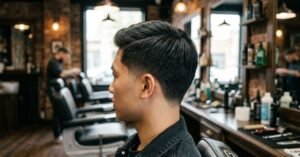
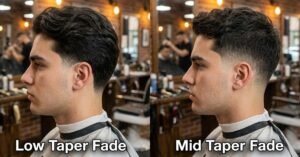
- Low fade. Starts just above the ear, close to the natural hairline. Conservative, professional, and the easiest to grow out.
- Mid fade. Starts around the temple, roughly halfway up the side of the head. The most versatile option and the one most barbers recommend for first timers.
- High fade. Starts near the top of the sides, close to the parietal ridge. Bold, dramatic, and best suited to men who want maximum contrast.
Any of these can be paired with a skin fade finish, where clippers or a razor take the shortest section down to bare scalp, or a taper finish, which never fully exposes the skin and keeps a slightly softer transition.]
Read more: Low vs Mid vs High Taper Fade: Which One Should You Choose?
Historical Evolution and Cultural Context
The fade traces back to U.S. military grooming standards of the 1940s and 1950s, when short, uniform cuts were required for discipline and hygiene.
From there, Black barbers reshaped the style through the decades, and by the mid 1980s the high top fade had become a cultural signature, popularized by hip hop artists and worn on album covers, in films, and on stage.
The barbershop itself grew into more than a place for a haircut. It became a community space, a place to talk politics, sports, and life, particularly within Black neighborhoods where it served as a rare space of autonomy and self expression.
That legacy is part of why the fade still carries weight today: it’s a hairstyle with a story, not just a trend.
Modern fades borrow from both traditions, blending military precision with the creative shaping and detailing that came out of hip hop era barbering.
Key Styles, Cut Anatomy, and Variations
Every fade shares the same core anatomy: a gradient zone, a blend line, and a top section that carries the style. From there, variations branch out:
- Taper fade. A gentler version that never goes fully to skin, keeping some length at the neckline and around the ears.
- Skin fade (bald fade). The gradient runs all the way to bare skin at the bottom, usually finished with a straight razor or foil shaver for a seamless edge.
- Burst fade. The fade curves around the ear in a semicircle instead of running in a straight line, often paired with longer top styles.
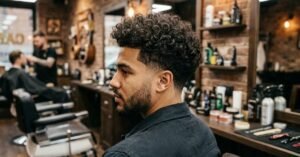
- Drop fade. The fade line dips downward behind the ear, adding visual width and working well with curly or coily hair.
- Temp fade (temple fade). A short, subtle fade confined to the temple area, popular for shorter overall styles.
- High top fade. A tall, boxy top paired with a heavily faded side, the signature look of 1980s and 1990s hip hop culture.
Each of these can be combined with a textured crop, pompadour, quiff, slick back, buzz cut, or faux hawk on top, which is why the fade functions as a base cut rather than a finished look on its own.
Face Shape and Hair Texture Compatibility Matrix
| Face Shape / Hair Type | Best Fade Level | Why It Works |
| Round face | Mid or high fade | Adds vertical lines that lengthen the face |
| Long or oval face | Low fade | Keeps proportions balanced without added height |
| Square face | Low to mid fade | Complements a strong jawline without overpowering it |
| Heart shaped face | Mid fade | Balances a wider forehead with a narrower chin |
| Straight hair | Low or mid fade | Shows off crisp lines and a sharp, clean gradient |
| Wavy hair | Mid to high fade | Creates contrast that highlights natural texture |
| Curly or coily hair | Low to mid fade with a skilled barber | Lets the curls on top stand out as the focal point |
| Thinning hair | Low to mid fade | Uses contrast to visually add fullness on top |
Step-by-Step Styling and Barber Execution Protocol
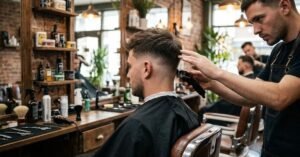
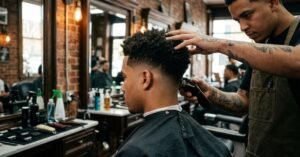
- Consultation. The barber checks hair growth pattern, cowlicks, and head shape before touching the clippers.
- Establish the guide line. A clipper guard sets the top length first, giving the barber a reference point for the fade.
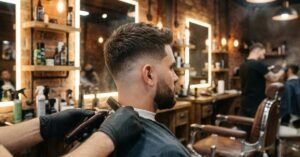
- Cut the base. Clippers move from the bottom up using the shortest guard, or a razor for a skin fade finish.
- Blend the gradient. The barber switches guards in sequence, working upward in overlapping passes to remove harsh lines.
- Detail the edges. A straight razor or edger sharpens the hairline, sideburns, and neckline.
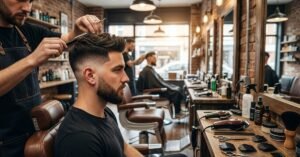
- Style the top. Product is applied while hair is slightly damp to set the final shape.
- Final check. The barber inspects both sides in a mirror for symmetry before finishing.
Essential Products, Formulations, and Styling Tools
- Clippers with multiple guard sizes for controlling the gradient at each stage.
- T-blade trimmers for sharp hairline and edge work.
- Matte clay or paste for textured, natural-looking finishes on top.
- Pomade for slicked, high-shine looks like a pompadour or slick back.
- Texture powder to add volume on fine or thin hair.
- Beard oil and aftershave balm to soothe skin after razor work along the fade line.
- A boar bristle brush to distribute product evenly and train hair direction.
Professional Barbershop Secrets and Edge Precision
Experienced barbers rarely rush the blend. The difference between an amateur fade and a professional one usually comes down to patience during the mid-section transition, where most of the guard changes happen. A few habits separate the best cuts:
- Working in small, overlapping sections rather than long single strokes.
- Checking the fade under strong, direct light to catch missed spots.
- Using a lower clipper setting for the hairline than for the fade itself, which keeps the edge crisp without making it look shaved in.
- Following the natural curve of the skull instead of a straight line, since heads are rarely symmetrical.
Read more: Best Haircuts for Diamond Face Shape (Male)
Common Haircut Mistakes and How to Avoid Them
- Fading too fast. Skipping guard sizes leaves visible lines instead of a smooth gradient. Ask your barber to blend gradually.
- Choosing the wrong fade height for your face shape. A high fade on a long face can stretch it further; check the compatibility matrix above first.
- Waiting too long between cuts. Fades grow out faster than other styles and need touch ups every one to three weeks.
- Skipping the consultation. Not communicating guard numbers and fade height clearly is the top cause of disappointing results.
- Neglecting scalp care. Dry, flaky skin is more visible on short, faded sides than on longer hair.
Seasonal Care and Maintenance Cadences
- Summer. Sweat and sun exposure call for lighter products and more frequent trims, roughly every one to two weeks, to keep the fade sharp.
- Winter. Cold, dry air can irritate freshly faded skin, so a moisturizing scalp oil helps prevent flaking; trims can stretch to three weeks.
- Spring and fall. A good time to experiment with fade height or add texture on top, since humidity levels are more moderate.
Barbershop Communication, Terminology, and Consultation Guide for Fade Haircuts
Walking in prepared makes a real difference in the outcome. Bring these details:
- Fade height: low, mid, or high.
- Finish: skin fade, taper fade, or a specific guard number at the shortest point.
- Top length: in inches or by guard number, plus whether you want texture added.
- Line up: whether you want the hairline and sideburns sharply defined.
- Reference photo: even a rough match helps the barber understand the shape you want.
Common terms to know include guard number (the clipper attachment size), blending (smoothing the transition between lengths), line up or edge up (defining the hairline), and skin fade (taking the shortest point down to bare scalp).
Blow-Drying Mechanics, Directional Airflow, and Pre-Styling Chemistry
Blow drying before styling sets the foundation for how the top will sit all day. Point the dryer nozzle in the direction you want the hair to fall, working from the roots outward on a medium heat setting. A light sea salt spray or volumizing mist applied before drying opens the hair cuticle slightly, helping product grip better afterward. Always finish with a cool shot of air to lock the shape in place before applying pomade, clay, or paste.
Scalp Health, Follicular Longevity, and Trimming Schedules
Short, faded sides expose more scalp than most haircuts, which means scalp health directly affects how the cut looks. A few habits help:
- Exfoliate the scalp once a week to prevent flaking and ingrown hairs.
- Use a lightweight, non-greasy oil if the skin feels tight or dry after a fresh cut.
- Trim every one to three weeks depending on how fast your hair grows and how sharp you want the fade to stay.
- Protect the scalp with SPF if you’re outdoors often, since a fresh fade leaves more skin exposed to sun.
Summary and Personal Aesthetic Philosophy
The fade endures because it’s genuinely flexible. It adapts to straight, wavy, curly, and coily hair, it flatters nearly every face shape when the height is chosen correctly, and it scales from subtle and professional to bold and expressive without changing its underlying technique.
Whether you’re new to fades or refining a style you’ve worn for years, the details covered here, from guard numbers to scalp care, are what separate a good cut from a great one.
Read more: Low Taper Fade Styles for Wavy Hair
Frequently Asked Questions
What is the difference between a low, mid, and high fade?
The difference is where the fade starts on the side of the head: low begins near the ear, mid begins at the temple, and high begins near the top of the head.
What is a skin fade compared to a regular fade?
A skin fade takes the shortest section all the way down to bare scalp, while a regular taper fade leaves a small amount of hair at the shortest point.
How often should I get a fade touched up?
Most fades need a touch up every one to three weeks, since the short sides grow out and lose their sharp gradient quickly.
Which fade style is best for a round face?
A mid or high fade works best for round faces because it adds vertical lines that make the face appear longer.
What is a drop fade haircut?
A drop fade curves the fade line downward behind the ear instead of running straight, adding visual width and pairing well with curly or coily hair.
What should I tell my barber to get the right fade?
Tell your barber the fade height, whether you want a skin finish, the desired top length, and whether you want a defined line up.

3 thoughts on “Fade Haircuts”