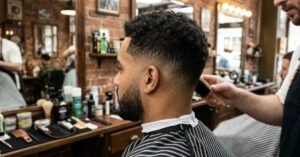
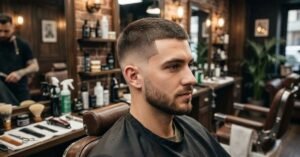
A mid taper fade middle part is a haircut that pairs a centered part on longer top hair with sides and back that shorten gradually, starting near the temple and ending at the neckline. It suits men who want a clean, balanced shape that still moves naturally.
The cut works best with roughly three to five inches on top, and it adapts to straight, wavy, and curly textures. Three things decide the result: telling your barber exactly where the taper starts, choosing a top length that can split and fall evenly, and using the right product for your hair type. Below you will find the words to say, a daily routine, six variations, and upkeep timing.
What is a mid taper fade middle part?

A mid taper fade middle part is a men’s haircut with a center part on top and a mid height taper on the sides and back. The top stays long enough to fall to both sides. The sides get shorter as they move down toward the ears and neck.
The words “taper” and “fade” are often mixed up. A taper shortens hair gradually and usually leaves a little length at the bottom. A fade can go down to bare skin. Many barbers blend the two terms, so it helps to say how short you want the bottom edge.
Where does the “mid” taper sit?
The “mid” refers to where the shortening begins. It usually starts around the temple, roughly level with the top of the ear, and blends down from there.
Here is how the three common starting points compare:
- Low taper: begins near the ear and nape, so most of the side stays full.
- Mid taper: begins around the temple, which gives a clear but balanced contrast.
- High taper: begins near the upper temple, which looks sharper and shows more skin.
Barbers place the start point differently, so point to the spot on your own head. That one gesture removes most of the guesswork.
Will a mid taper fade middle part work for your hair?

It works for most hair types, as long as you have enough length on top and a part that sits naturally. The cut depends on how your hair grows, not only on how you style it. Check length, texture, and growth patterns before you book.
How long should your hair be for the middle part?
| Top length | What you get | Best for |
| 2.5 to 3 inches | Short, neat part that can lift at the front | Straight, fine hair |
| 3 to 4 inches | Clear part with light movement | Most textures |
| 4 to 6 inches | Curtain flow that tucks behind the ears | Wavy, thick hair |
Which hair textures and densities work best?
Straight and wavy hair split most easily. Curly and coily hair also works well and gives the part a fuller, rounder shape. Fine hair needs a little lift so the part does not look flat. Thick hair benefits from thinning with shears so it sits closer to the head.
Density matters as much as texture. Thin hair shows the scalp along the part, so a softer, less defined line looks better. Very dense hair can puff outward, so ask for weight removal on the top.
What about face shape, hairline, cowlicks, and head shape?
A center part adds length to a round face and frames a long face if the sides keep some width. Square and oval faces handle it easily.
Check these before your appointment:
- Hairline: A high or receding hairline looks fine with a middle part. A low, uneven hairline may need a slightly softer part.
- Cowlicks: A cowlick at the front hairline can push the part off center. Ask your barber to cut with the grain and keep extra length there.
- Crown swirl: A strong swirl can twist the back. Leaving more length helps it lie flat.
- Head shape: A flat back of the head can look more obvious with a tight taper. A slightly longer neckline softens it.
How do you ask your barber for a mid taper fade middle part?
Say “mid taper, longer on top, centered part” and add your top length and bottom finish. Then show a photo. Clear details prevent the two most common mix ups, which are a taper that starts too high and a top that is cut too short to part.
What details should you specify before the first cut?
Cover these points so nothing is left to guesswork:
- Taper height: “Start the taper at my temple.”
- Bottom finish: Natural taper, short guard, or skin.
- Top length: Give a number, such as “about four inches.”
- Part: Natural center or sharply defined.
- Neckline: Rounded, squared, or blended.
- Edges: Keep the natural hairline or add a line up, which is a crisp outline around the forehead and sideburns.
A guard number is the plastic clipper attachment that sets cutting length. Many barbers start the lower taper around a number one or two guard, but this varies. Ask what they plan to use if you want to avoid surprises.
What should your barber script and reference photos include?
Try this short script: “I would like a mid taper starting at the temple, blended with scissors on the sides. Keep about four inches on top, cut so it parts naturally down the center. Leave the hairline natural.”
Bring two or three photos. Pick one from the front, one from the side, and one that shows your hair texture. Photos of the wrong texture create wrong expectations, so match yours as closely as possible.
How do you style a mid taper fade middle part at home?
Style it on damp or towel dried hair. Set the part first, then dry and shape. The whole routine takes about five minutes once you know your hair.
What is the 5-step daily styling routine?
- Dampen: Wet your hair lightly or mist it with water.
- Find the part: Use a comb and your nose as a guide, then draw a straight line back from the center of the forehead.
- Dry: Blow dry on medium heat with a vent brush, directing hair away from the part.
- Add product: Warm a dime sized amount in your palms and work it through from roots to ends.
- Finish: Shape with your fingers or a comb, and add a light mist of spray if needed.
Do not skip step three. Drying in the right direction trains the hair to hold the part for the rest of the day.
Which products fit straight, wavy, curly, fine, or thick hair?
| Hair type | Product | Finish |
| Straight | Light cream or matte paste | Natural, soft |
| Wavy | Sea salt spray or light mousse | Textured |
| Curly or coily | Curl cream or leave in conditioner | Defined, moisturized |
| Fine | Texture powder or volumizing spray | Fuller |
| Thick | Medium hold pomade or paste | Controlled |
Which mid taper fade middle part variations are worth showing your barber?
The best variation is the one that matches your texture and how much effort you want to spend. Each version below changes the finish, not the core structure.
Which version matches your texture and preferred finish?
Pick by texture first, then by how polished you want to look. Straight hair suits curtain flow. Wavy hair suits a relaxed, tousled version. Curly hair suits a rounder, fuller shape. If you like a sharper edge, choose the higher contrast finish.
Classic curtain flow

Four to five inches on top, parted in the center, falling gently to each side. Ask for light layering at the ends so it tucks behind the ears.
Textured or messy middle part

Ask the barber to cut into the top with scissors for movement. Style with matte paste and rough it up with your fingers. It looks relaxed and hides small mistakes in the part.
Wavy middle part

Wavy hair needs weight removal so it does not triangle outward. Use sea salt spray on damp hair and let it dry naturally or diffuse it for shape.
Curly or coily middle part

Keep more length on top so the curls can fall on both sides. The taper adds shape and contrast. Use a curl cream and avoid brushing dry curls, which causes frizz.
Fluffy or high-volume middle part

Ask for the top to be cut a little longer at the front, then blow dry upward before parting. This works well on thick or fine hair that needs lift.
Skin-close, higher-contrast finish
Ask for a skin taper at the bottom while keeping the top long. It looks sharp but needs more frequent visits, because skin level lines grow out fast.
How does a mid taper fade middle part compare with similar haircuts?
| Haircut | Taper start | Contrast | Upkeep |
| Low taper middle part | Near ear and nape | Soft | Low |
| Mid taper middle part | Around temple | Medium | Medium |
| Mid fade middle part | Temple, often to skin | Higher | High |
| Scissor cut curtains | None or very slight | Minimal | Low |
| Side part taper | Varies | Medium | Medium |
Mid taper middle part vs low taper middle part
A low taper keeps more length on the sides, so the head looks fuller and the look is softer. A mid taper removes more side weight, which makes the center part stand out. Choose low if you want subtle, mid if you want more shape.
Mid taper fade middle part vs mid fade middle part
A mid fade usually cuts shorter and may go to skin. A mid taper keeps a little length at the edge. If you dislike seeing bare skin around the ears, ask for a taper, not a fade.
Mid taper middle part vs scissor-cut curtains
Scissor cut curtains are all shears with no clipper work, so the sides stay full and soft. A mid taper adds a clean, shorter edge around the ears and neck. Curtains feel more relaxed, while the taper looks more structured.
Middle part vs side-part taper
A side part is asymmetrical and often looks more classic or formal. A center part is balanced and fits a more modern, casual look. A side part may suit a strong jaw or a wider forehead, while a middle part suits symmetrical features.
How do you maintain it, grow it out, and avoid common mistakes?
Refresh the sides often, trim the top less often, and fix problems at the first sign. The taper fades out of shape faster than the top does.
How often should you refresh the taper and reshape the top?
- Taper and neckline: every 2 to 4 weeks, especially with a skin finish.
- Top reshaping: every 6 to 8 weeks.
- Quick line up only: between full cuts if you like crisp edges.
Book the next visit before you leave the shop. It keeps the schedule consistent and the shape predictable.
What makes the haircut look wrong, and how do you fix it?
- Part looks uneven: Re-comb from the hairline back, not from the middle outward.
- Top looks flat: Add texture powder and blow dry upward at the roots.
- Sides look puffy: Book an early taper cleanup.
- Top too short to part: Grow it out another month and ask for only the sides to be trimmed.
Can heat styling or a very close finish cause problems?
Yes. Daily high heat can dry out hair and weaken the ends, so use medium heat and a heat protectant spray. A very close skin finish can cause razor irritation or ingrown hairs, so avoid shaving the edges too often and moisturize the skin after each cut.
Frequently asked questions
What is a mid taper fade middle part?
It is a haircut with a center part on longer top hair and sides that shorten gradually from the temple down.
How long should hair be for a mid taper fade middle part?
You need at least three inches on top, and four to five inches gives a softer curtain flow.
Is a mid taper the same as a mid fade?
No. A mid taper keeps a little length at the edge, while a mid fade usually cuts shorter and often to skin.
How often should I get a mid taper fade middle part cut?
Refresh the sides every two to four weeks and the top every six to eight weeks.
Does a middle part suit a round face?
Yes. A center part adds vertical length and can balance a round face, especially with some height on top.
Can curly hair have a middle part with a taper?
Yes. Keep extra length on top, use a curl cream, and ask for a taper that blends into the curls.
Is a mid taper fade middle part the right cut for you?
It is a good fit if you have at least three inches of hair on top, a part that sits naturally, and a willingness to refresh the sides every few weeks. It suits most face shapes and textures, and it works for both work and casual settings.
Before you book, decide on your taper height, bottom finish, and top length. Bring photos that match your texture, say where the taper should start, and style it with the right product. With clear communication and a simple routine, the cut stays sharp and easy to wear.
Want more taper fade guides?
If you liked this one, explore our other taper and fade guides next, such as low taper, high taper, and curly hair taper styles. Each one breaks down the barber script, styling steps, and upkeep schedule so you can pick the cut that fits your hair best.