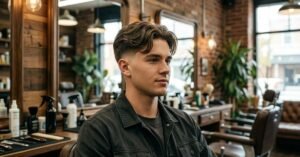
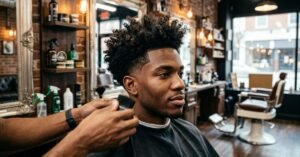
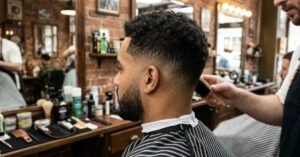
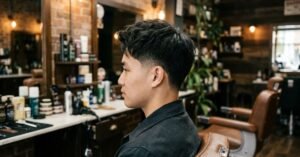
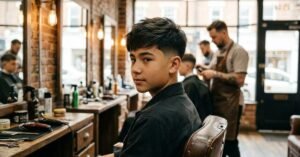
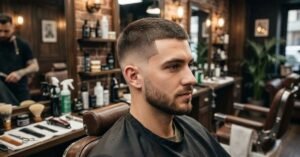
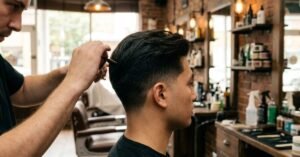
A low drop fade is a fade that starts low on the sides and curves down behind the ear, following the shape of your skull instead of running in a flat line. It keeps the sides clean without exposing much scalp, so it suits office, gym and weekend looks alike.
This guide explains what the cut is, how it differs from the low fade, taper and mid drop, and which top styles pair best with each hair type. You will also get a barber script, a step by step view of how the cut is built, and a realistic upkeep plan. Use it to book your next appointment with exact words and fewer surprises in the mirror.
What is a low drop fade?

A low drop fade is a haircut where the hair gets gradually shorter toward the bottom of the head, and the fade line begins low and arcs downward behind the ear. The curve is the key feature. It hugs the back of the skull, so the cut looks rounded and intentional rather than boxy.
Quick facts:
- Start point: near the top of the ear, well below the temple.
- Line shape: a curve that dips behind the ear toward the nape.
- Finish: skin, zero, shadow or a short guard length.
- Top: anything from a buzz to several inches of length.
What does “low” mean in a low drop fade?
“Low” describes where the fade begins. Picture the sides of your head in three zones: the lower zone near the ear and nape, the middle zone, and the upper temple zone. A low fade stays in the lower zone, so most of the side hair keeps its natural length.
That has practical benefits:
- It looks softer and more office friendly than a high fade.
- It keeps hair around the temples, which helps if you have a receding hairline.
- It leaves more room for a longer top and a neat side part.
What does “drop” mean?
“Drop” describes the direction of the line. Instead of staying level, the fade line dips behind the ear and follows the curve of the skull. Barbers often track the occipital bone, the bony bump at the lower back of the head, to place the lowest point of the arc.
The result is a fade that sits higher near the front and lower at the nape. This shape flatters most head profiles because it echoes the natural curve of the skull.
Skin, zero or shadow: how short can it finish?
The finish is the shortest point of the fade. Choose it before the cut, because it changes both the look and the upkeep.
- Skin (bald) fade: shaved smooth with a foil shaver or trimmer. It gives the sharpest contrast and grows out fastest.
- Zero fade: clippers set to a zero gap, which leaves a trace of stubble. It is close but not glossy.
- Shadow fade: starts around a #0.5 to #1 guard (roughly 1.5 to 3 mm). It reads as a soft shadow and is easier on the skin.
- Guarded base: a #1 or #2 guard (about 3 to 6 mm) for a conservative, low contrast look.
Guard numbers come from clipper makers such as Wahl, an American brand whose sizes most barbershops follow. Numbers can differ slightly between brands, so say the length in millimetres or inches if you are unsure.
Low drop fade vs similar haircuts
| Haircut | Fade line | Starting height | Best for |
| Low drop fade | Curves down behind the ear | Low | Clean sides with a natural look |
| Low fade | Stays mostly level | Low | Classic, symmetrical finish |
| Low taper | Short only at sideburns and neckline | Very low | Conservative, minimal change |
| Mid drop fade | Curves down behind the ear | Mid (near the temple) | Stronger contrast, more scalp shown |
| Low burst fade | Semicircle around the ear | Low | Longer back, mullet or curly shapes |
Low drop fade vs low fade

Both start low. The difference is the line. A low fade tends to run around the head at a similar height, while a low drop fade dips behind the ear. The drop gives a rounder, more skull-following shape and often looks tidier around the ear.
Low drop fade vs low taper

A taper shortens hair gradually, but usually only around the sideburns and the nape, and it rarely reaches skin. A low drop fade covers more of the side and back and can finish much shorter, so the contrast is more visible. If you want the smallest possible change, ask for a taper.
Low drop fade vs mid drop fade
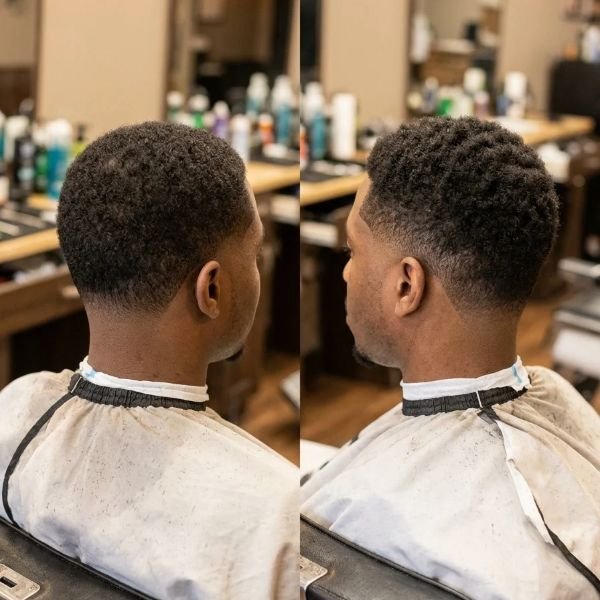
The mid drop uses the same curved line but begins higher, near the temple. That exposes more scalp and creates stronger contrast. The low version is the safer choice for conservative workplaces, thinning temples and longer tops.
Low drop fade vs low burst fade

A burst fade fades in a semicircle around the ear and leaves the back and nape longer. A low drop fade runs all the way around to the nape. Choose the burst if you want length at the back, as with a mullet or a curly top.
Who does a low drop fade work for?
It works for most men and many women with short sides, because the starting height and finish can be adjusted. Fit depends on hair behavior and head shape more than age or profession.
Hair texture, density and growth pattern
- Fine or straight hair: blends cleanly, but a skin finish can show scalp. A shadow finish looks fuller.
- Thick hair: easy to blend and holds a crisp arc.
- Curly or coily hair: gives strong definition and a clear contrast with the top.
- Cowlicks and whorls: a cowlick is a patch where hair grows in a different direction. At the crown or nape it can make the edge look uneven, so ask your barber to cut with the grain there.
- Thinning at the temples: the low start keeps hair where you need it. Avoid skin and pick a shadow or guarded finish.
Head shape, neck shape and upkeep
Because the line follows the skull, the cut suits most head shapes. A flatter back of the head gains a visible curve from the drop. Bumps, scars or birthmarks near the ear are better covered by a shadow finish than by skin.
The neckline matters for upkeep. A blocked (square) nape looks sharp on day one but shows grow-out within a week. A rounded or tapered nape fades into the skin and ages more gracefully.
Low drop fade styles by hair type and top shape
Pick the top first, then match the fade to it. The sides frame the top, so contrast and length should work together.
Low drop fade for straight and wavy hair

Straight hair shows the cleanest blend, but it also shows mistakes. Keep the top 4 to 7 cm for a side part or a textured finish. Wavy hair adds natural movement, so a slightly longer top lets the wave show without extra product.
Low drop fade for curly, coily hair and waves

Curls and coils make the fade pop. Keep enough length on top (often 5 to 8 cm for curls) so the pattern can form. Waves (the 360 or brush wave pattern) need a smooth, closely cut surface, so many wearers choose a guarded base and a clean neckline. Ask for no blunt line at the nape if you want a softer grow-out.
Textured crop, French crop and fringe

A textured crop is a short, choppy top with matte texture. A French crop is the same idea with a straight, short fringe (bangs) cut across the forehead. Both pair well with a skin or shadow finish because the contrast sharpens the fringe. Aim for about 2.5 to 5 cm on top.
Buzz cut and crew cut

A buzz cut uses one guard length over the whole head. A crew cut keeps the top slightly longer than the sides. A low drop fade turns either into a cleaner, more modern shape. Use a guarded base for a low maintenance version.
Quiff, side part and slick back
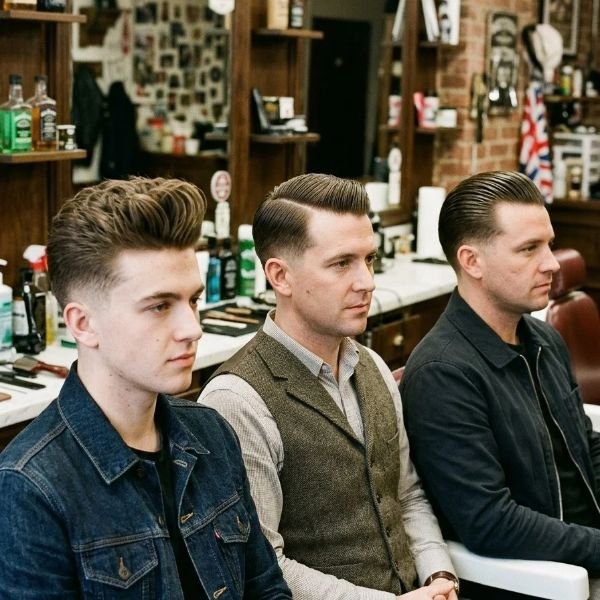
These longer styles (about 6 to 10 cm on top) need a subtle fade so the sides do not fight the top. A low drop fade with a shadow or guarded finish keeps the look polished. For a slick back, keep the line low so it does not expose the ears too much.
Beard blend and line-up

A beard blend connects the fade to the beard so the hair thins smoothly from sideburn to cheek. A line-up (also called an edge-up or shape-up) is a crisp edge at the forehead and temples cut with a trimmer or razor. Ask your barber to match the fade’s finish to the beard’s shortest point. If you shave the cheek line, see the skin care section below.
How to ask your barber for a low drop fade
Vague words like “a fade” cause most bad haircuts. Give the barber a few measurable details and a visual reference.
Choose these five specs before the cut
- Start height: low, about one finger above the ear.
- Finish: skin, zero, shadow or a guard number.
- Top length: in inches, centimetres or finger widths.
- Top shape: crop, quiff, side part, curls and so on.
- Neckline and beard: blocked, rounded or tapered, plus a beard blend if you have one.
Bring the right reference photos
Photos beat adjectives. Use these rules:
- Bring two or three images from the front, side and back.
- Match your hair texture and color as closely as you can.
- Point to what you like, such as the line height or the finish.
- Show one example you do not want.
- Avoid heavily filtered images, since lighting can hide the real line.
Use a one-sentence barber brief
Combine the five specs into one clear sentence. Here are three versions.
Guarded base
“Low drop fade starting a finger above the ear, finishing at a number 1 guard, about 4 cm on top, with a tapered neckline.”
Skin base
“Low drop skin fade curving behind the ear, blended into 5 cm of textured length on top, with a rounded neckline.”
Curly or coily top
“Low drop fade with a shadow finish, keeping my curls about 6 cm on top, with no blunt line at the nape.”
How a barber builds a low drop fade
Knowing the process helps you judge the result and ask smarter questions.
Set the curved guideline and check symmetry
- Read the head. The barber checks head shape, cowlicks and growth direction, ideally on dry hair.
- Mark the guideline. Using clippers or a trimmer, they draw the arc: low above the ear, then curving behind it toward the occipital bone.
- Check both sides. They compare the distance from the ear on each side, step back, and look from the front and back.
- Clear the base. The shortest section is cut up to the line at the chosen finish.
Blend the zones without pushing the fade too high
Blending uses clipper-over-comb work and lever movement to step through lengths, for example a #0.5, then #1, then #1.5, until the base melts into the top. The danger is chasing smoothness. Every extra pass can lift the fade higher than planned.
A skilled barber stops at the guideline, checks by touch as well as by sight, and then details the ear and neckline with a trimmer or razor. If your fade ends up higher than you asked for, it is usually because the blending crept upward.
How to style and maintain a low drop fade
The fade gets the attention, but the top finishes the look. Good products and a regular schedule keep both sharp.
Style the top by hair type
- Straight or fine: sea salt spray or light powder for lift, then a flexible hold.
- Wavy: a light cream, scrunched in while damp.
- Curly: leave-in conditioner plus curl cream, then let it air dry or diffuse.
- Coily: a moisturizer and a sealing oil or butter. A twist-out or finger coils define the pattern.
- Crops and textured tops: matte clay for a dry finish.
- Slick back or side part: pomade or a light gel for shine and control.
How often should you refresh the fade?
| Finish | Typical refresh | Why |
| Skin | About 2 weeks | Contrast fades fast as stubble appears |
| Zero or shadow | 2 to 3 weeks | Softer grow-out |
| Guarded base | 3 to 4 weeks | Smaller contrast hides growth |
Skin comfort with very close fades
Close cuts can irritate the skin around the ears and nape. The main concern is razor bumps, medically called pseudofolliculitis barbae (PFB). It happens when a shaved hair grows back, curls and pierces the skin.
People with coarse or curly hair are more likely to get razor bumps. A review in a dermatology journal, <a href=”https://pubmed.ncbi.nlm.nih.gov/31354326/”>Ogunbiyi, 2019</a>, covers treatment options in more detail. goodrx
The American Academy of Dermatology (AAD), a professional body of dermatologists, says that changing shaving habits can help prevent razor bumps or make them less painful.
Its advice on <a href=”https://aad.org/news/how-to-prevent-razor-bumps”>how to prevent razor bumps</a> includes shaving in the direction your hair grows and applying a soothing aftershave. aadnewswise
Practical steps:
- Choose a shadow or guarded finish if your skin is sensitive.
- Skip repeated passes over the same area.
- Use a cool compress if the skin feels irritated.
- Apply sunscreen to newly exposed skin around the ears and neck.
- See a board-certified dermatologist if bumps persist, because untreated razor bumps can leave scars. orthoatlanta
Common low drop fade mistakes and how to avoid them
- Asking for “a fade” only. Give start height, finish, top length and neckline.
- Letting the fade climb too high. Say “low” and point to the ear or temple on yourself.
- Picking skin on fine or thinning hair. A shadow finish looks fuller.
- Ignoring cowlicks. Mention them so the barber cuts with the grain.
- Skipping the neckline decision. Blocked lines grow out fast. Rounded or tapered ones last longer.
- Stretching the time between cuts. Book the next visit before you leave.
- Using mismatched photos. Choose references with your hair texture and density.
Low drop fade FAQs
What is a low drop fade?
It is a fade that starts low on the sides and curves downward behind the ear, following the shape of the skull.
How low should a low drop fade start?
Usually about a finger width above the ear, well below the temple.
Is a low drop fade the same as a low fade?
No. Both start low, but a low drop fade curves down behind the ear while a low fade stays mostly level.
Is a low drop fade good for curly hair?
Yes. It frames curls and coils cleanly if you keep enough length on top for the pattern to form.
How often should I get a low drop fade?
Every 2 weeks for a skin fade, 2 to 3 weeks for zero or shadow, and 3 to 4 weeks for a guarded base.
Can I get a low drop fade with a beard?
Yes. Ask for a beard blend so the fade connects smoothly to the sideburn and cheek line.
Does a low drop fade suit thinning hair?
Often, yes. The low start keeps hair at the temples, and a shadow finish looks fuller than skin.